




Start with Your Foundation: Seat Height
Proper posture begins from the ground up. Start by adjusting your chair’s height until your feet can rest flat on the floor. Your knees should form a 90-degree angle, with your hips sitting level with or slightly higher than your knees. This alignment
helps distribute your body weight evenly and reduces pressure on your lower back. If your desk is high and adjusting your chair leaves your feet dangling, don’t compromise. Grab a stack of sturdy books or a dedicated footrest to provide a solid base. Keeping your feet grounded is the first and most critical step to stabilising your entire posture.
Mind the Gap: Setting Seat Depth
Next, ensure you are using the full depth of your chair. Sit back so that your spine is making contact with the backrest. From there, check the space between the front edge of your seat and the back of your knees. You should have a small gap of about two to three fingers' width. If your seat is too deep and presses against your calves, it can restrict blood circulation. If it’s too shallow, you lose essential thigh support. Many ergonomic chairs have a seat slide function to make this adjustment easy. If yours doesn’t, and the seat feels too deep, placing a small cushion behind your back can create the necessary space.
Support Your Spine: Lock in Lumbar Support
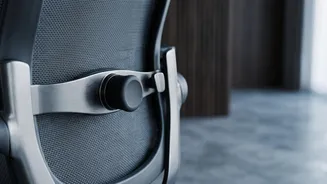
Your lower spine has a natural inward curve, and your chair should support it. A common cause of back pain is slouching, which flattens this curve and puts pressure on your spinal discs. Adjust the lumbar support on your chair so its most prominent point fits snugly into the small of your back, roughly around your belt line. You should feel supported but not aggressively pushed forward. If your chair lacks adjustable lumbar support, an easy and effective fix is to use a rolled-up towel or a small, firm pillow placed in the curve of your lower back.
Find Your Angle: The Backrest Recline
Sitting perfectly upright at a 90-degree angle isn't necessarily the best position for your spine. In fact, a slight recline can do more to relieve pressure. Experts often recommend setting your backrest to an angle between 100 and 110 degrees. This open angle helps to reduce the load on your intervertebral discs. Your chair’s tilt tension should be adjusted so you can lean back with minimal effort but without feeling like you are going to fall backward. The goal is to find a supported, relaxed position rather than a rigid, upright one.
Give Your Arms a Rest: Positioning Armrests
Armrests play a crucial role in reducing strain on your shoulders and neck. Adjust their height so that your elbows can rest at a comfortable 90-degree angle when your shoulders are relaxed. Your forearms should be roughly parallel to the floor. If the armrests are too high, they will force you to hunch your shoulders; if they are too low, they provide no support at all. The armrests should be close enough to your body to support your arms without you having to splay your elbows outwards. Proper armrest positioning allows the muscles in your neck and shoulders to take a much-needed break throughout the day.
Beyond the Chair: The Importance of Movement
Even the world’s most perfectly adjusted ergonomic chair cannot defeat the negative effects of a completely sedentary day. Static posture is the enemy of spinal health. To combat this, make it a rule to change your position frequently. Aim to stand up, stretch, or walk for a minute or two every 30 to 50 minutes. These small microbreaks improve circulation, reduce muscle fatigue, and give your body a reset from the fixed sitting position. Think of your ergonomic setup not as a way to sit still for longer, but as a tool to make your seated time as healthy and comfortable as possible in between periods of movement.