
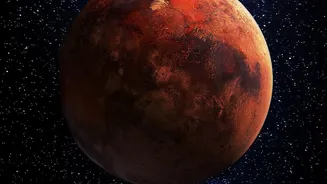
Scattered throughout the cosmos are 'failed stars' known as brown dwarfs, objects that are not quite stars and not quite planets. New data from NASA's SPHEREx telescope suggests our understanding of their wild, cloudy atmospheres may be wrong.
The Cosmic Middle Ground
Imagine
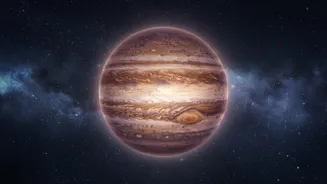
an object more massive than Jupiter but not massive enough to ignite into a star. That's a brown dwarf. They form from collapsing clouds of gas, just like stars, but they lack the sheer mass needed to start the process of nuclear fusion in their cores, which is what makes stars like our Sun shine. Instead, they glow faintly from the heat left over from their formation, slowly cooling over billions of years. Because they are often found drifting alone in space without the glare of a parent star, they serve as perfect laboratories for studying atmospheres that are similar to those of giant exoplanets. Understanding their weather—which can include planet-sized storms and clouds of hot sand or molten iron—gives us a window into the atmospheric physics of worlds far beyond our solar system.
A New Eye on the Sky
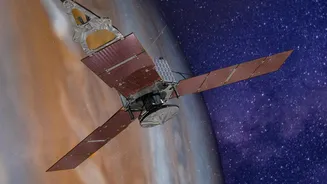
Enter SPHEREx, NASA's Spectro-Photometer for the History of the Universe, Epoch of Reionization, and Ices Explorer. Launched in March 2025, this space telescope is on a two-year mission to map the entire sky in 102 different colors of light, mostly in the infrared spectrum. While its primary goals are to study the origins of the universe and galaxies, this powerful survey capability has a significant side benefit: it can study thousands of brown dwarfs. Before SPHEREx, only a few dozen of these dim objects had been studied in detail. The telescope's ability to capture a broad spectrum of infrared light allows scientists to identify the chemical signatures of molecules like water, methane, and carbon dioxide in their atmospheres.
The Old Weather Forecast
For years, scientists have tried to model the atmospheres of brown dwarfs. Early observations with telescopes like NASA's Spitzer revealed that many brown dwarfs have their brightness vary rapidly, sometimes in less than a day, suggesting massive, stormy weather systems. The prevailing models tried to explain this by picturing patchy cloud cover, with clear, hotter regions rotating into and out of view, causing the brightness to fluctuate. These clouds, thought to be made of materials like silicates and iron, were believed to exist in bands, similar to Jupiter's distinct zones. However, these models often struggled. They were based on one-dimensional simulations and had trouble accounting for the speed of the changes and the incredible diversity seen among brown dwarfs, even those with the same temperature.
A Storm of New Data
The latest study, analyzing data from 37 nearby brown dwarfs observed by SPHEREx, has thrown a wrench into these established ideas. The findings, published in The Astrophysical Journal, reveal that existing models are falling short, particularly for brown dwarfs in a key transitional phase of their lives. As these objects cool, their clouds are expected to thin out, allowing methane gas to become a dominant feature in their spectra. However, the SPHEREx data shows that this process is far more complex and varied than predicted. According to lead author Zafar Rustamkulov, two brown dwarfs at the same temperature can have strikingly different spectra, a diversity that current models cannot explain. This suggests the relationship between temperature, cloud cover, and chemical composition is not as straightforward as once believed.
Rethinking the 'Failed Stars'
This new research challenges the scientific community to develop more sophisticated, threendimensional models of brown dwarf atmospheres. The fact that 'no two brown dwarfs are alike' points to complex variables at play, which could include differences in atmospheric circulation, the size of cloud particles, or even the presence of powerful atmospheric waves. J. Davy Kirkpatrick, a coauthor of the study, noted that the work has turned the team into 'accidental meteorologists', highlighting the immense challenge of predicting weather on these distant worlds. By pushing the boundaries of our current understanding, the SPHEREx data is forcing a rewrite of the atmospheric rulebook for these celestial objects. This will not only deepen our knowledge of brown dwarfs but also refine our search for and analysis of potentially habitable exoplanets, which are much harder to study directly.