




A Tale of Two Faces
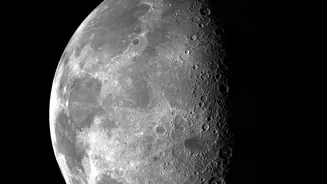
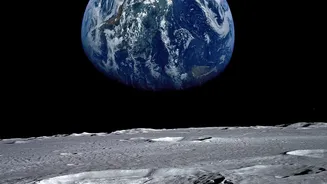
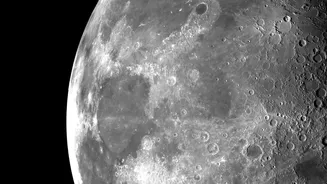
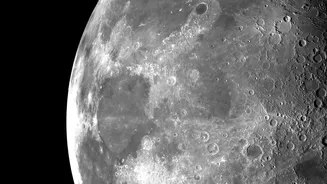
Anyone who has looked at the night sky is familiar with the 'man in the Moon' — the vast, dark plains of cooled lava that dominate the side of the Moon facing Earth. Early astronomers called these features 'maria', Latin for 'seas'. But this familiar face
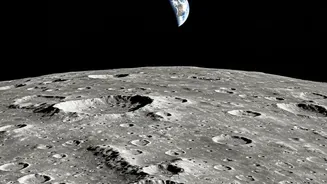
is only half the story. When the Soviet Luna 3 probe first photographed the lunar farside in 1959, it revealed a completely different world. Instead of smooth maria, the farside is a rugged, heavily cratered expanse with a much thicker crust. This stark division, known as the lunar dichotomy, has been one of the most significant open questions in lunar science, pointing to a fundamental asymmetry established early in the Moon's life.
An Ancient, Asymmetric Beginning
The leading theory for the Moon's birth is the Giant-Impact Hypothesis, which posits that a Mars-sized object named Theia slammed into a young Earth, flinging debris into orbit that eventually coalesced to form the Moon. For a long time, one theory for the two-faced Moon was that after it became tidally locked, the nearside was constantly exposed to the radiant heat of a still-molten Earth. This kept the nearside hotter for longer, resulting in a thinner crust that magma could more easily break through to form the maria. The farside, facing cold space, cooled faster and developed a thicker, more resilient crust. While this explains part of the picture, it doesn't fully account for the specific chemical differences between the two hemispheres.
A Colossal Impact Changes Everything
A compelling new explanation connects the lunar dichotomy to another cataclysmic event: the formation of the South Pole–Aitken (SPA) basin. This is the largest and oldest confirmed impact structure on the Moon, a gargantuan crater stretching nearly a quarter of the lunar surface on the farside. According to recent computer simulations, the tremendous energy from the impact that created this basin—billions of years ago—would have sent a massive plume of heat through the Moon's interior. This heat wave propagated through the lunar mantle, fundamentally altering its internal dynamics and setting the stage for the contrast we see today.
The Key Ingredient: KREEP
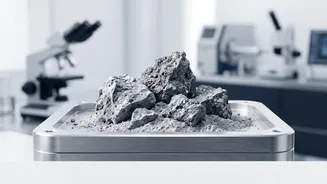
The secret to the nearside's unique geology lies in a specific cocktail of materials. The nearside is home to a geochemical anomaly known as the Procellarum KREEP Terrane (PKT). KREEP is an acronym for rocks rich in potassium (K), rare-earth elements (REE), and phosphorus (P), as well as heat-producing radioactive elements like thorium. This material is thought to be the last part of the Moon’s ancient magma ocean to solidify. The heat plume from the SPA impact acted like a wave, effectively pushing and concentrating this KREEP material, which was initially distributed more evenly, towards the nearside. This created a massive concentration of heat-producing elements on one side of the Moon.
Locking in the Contrast
The concentration of KREEP on the nearside had a profound effect. These heat-producing elements acted like a thermal blanket, keeping the nearside mantle hotter for hundreds of millions of years. This sustained heat lowered the melting point of the rock beneath the crust, fueling the prolonged and extensive volcanism that formed the vast maria we see from Earth. In essence, the colossal impact on the farside created a chain reaction that concentrated volcanic fuel on the nearside. This means the Moon's two-faced nature wasn't just a surface-level feature, but a deep-seated reality baked in by one of the most significant events in lunar history.