




A Breakthrough Billions of Kilometres Away
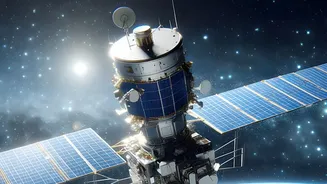
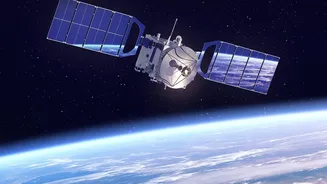
NASA has successfully demonstrated that it can stream high-bandwidth video and other data from deep space at unprecedented speeds. The technology, called Deep Space Optical Communications (DSOC), was tested aboard the Psyche spacecraft, which launched
in October 2023. In a milestone achievement, the system beamed an ultra-high-definition video from 31 million kilometres away. The 15-second clip, which playfully featured a cat named Taters, was transmitted at a maximum rate of 267 megabits per second (Mbps)—a speed comparable to many home broadband plans. The signal took 101 seconds to reach the Hale Telescope at Caltech's Palomar Observatory in California. This successful test is a pivotal moment, proving that laser communications can work reliably over vast interplanetary distances.
How Lasers Outshine Radio Waves
For decades, space missions have relied on radio frequency (RF) systems to send data back to Earth. While reliable, RF technology is like a narrow pipe, limiting how much information can be sent at once. This has created a bottleneck, especially as modern scientific instruments generate massive amounts of data. Laser communications, or optical communications, offer a solution by using near-infrared light instead of radio waves. Because light waves are packed much more tightly than radio waves, they can carry significantly more data—between 10 and 100 times more than current RF systems. This allows for the transmission of complex scientific information, high-definition images, and even live video feeds, something that was previously impossible from deep space. Furthermore, laser communication systems are smaller, lighter, and require less power, freeing up valuable mass and energy for other scientific instruments on a spacecraft.
The Challenge of Hitting a Faraway Target
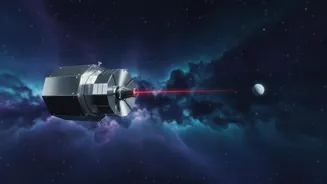
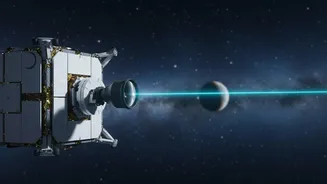
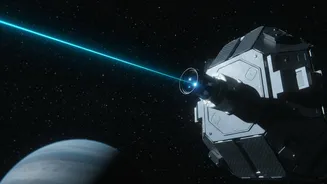
Transmitting a laser beam across millions of kilometres is an immense technical challenge that requires incredible precision. The laser beam is very narrow, so pointing it accurately from a moving spacecraft to a telescope on Earth is like trying to hit a moving coin from a kilometre away. To achieve this, the DSOC system uses a sophisticated 'uplink' beacon from Earth. A ground-based laser at NASA's Table Mountain facility is aimed at the spacecraft, acting as a guide. The transceiver on the Psyche spacecraft then locks onto this beacon to stabilize its own laser and transmit its high-rate data beam back to the receiver at the Palomar Observatory. This advanced pointing and tracking system has proven to be highly effective, even demonstrating the ability to work during the day and through thin clouds.
An Interplanetary Internet for Future Explorers
The success of the DSOC experiment is more than just a technical demonstration; it lays the foundation for the future of human and robotic exploration. As NASA plans for crewed missions to Mars, the need for robust, high-speed communication is critical. This technology will allow astronauts to send back high-definition video of their experiences and enable mission controllers on Earth to receive real-time data on life support systems and scientific discoveries. It opens the door for a true interplanetary internet, where information can flow seamlessly between Earth, the Moon, Mars, and beyond. The DSOC demonstration, which successfully completed its two-year mission in September 2025, has already transmitted over 13 terabits of data, proving its readiness to support the next generation of ambitious deep-space ventures.