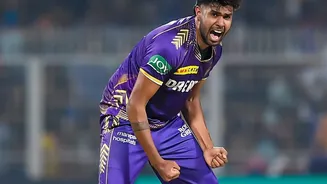







Harshit Rana is the talk of the Rising Stars Asia Cup 2026. With every searing delivery and crucial wicket comes a fiery send-off. But is his confrontational style a sign of a passionate winner or a liability that overshadows his undeniable talent?
The Performance Speaks Volumes
Before
dissecting the drama, let's acknowledge the talent. Harshit Rana is not in the Indian setup by accident. He is a genuine match-winner. His performance in the ongoing tournament has been pivotal, especially in high-pressure situations. In the recent clash against Pakistan A, after a tough start where he conceded runs, he fought back to dismiss Rohail Nazir and finished his spell economically. This mirrors the grit he showed in the IPL, most notably in the 2024 season where he was instrumental in Kolkata Knight Riders' title win, taking 19 wickets. He has a knack for breaking partnerships and taking crucial wickets at the death. His ability to generate pace and bounce, combined with a deceptive slower ball, makes him a potent weapon in any captain's arsenal. The statistics back him up; a career IPL strike rate in the mid-16s proves he is, first and foremost, a wicket-taker. Without these performances, his attitude would be an empty gesture.
A Walking Code of Conduct Breach?
However, the performances often come with a side of controversy. Rana's career is already dotted with fines and warnings for his aggressive on-field behaviour. During the IPL 2024 season, he was fined 60% of his match fee for giving Mayank Agarwal a 'flying kiss' send-off and was later suspended for a match and fined 100% of his fee for a similar outburst against Delhi Capitals. This pattern has continued. At the current Rising Stars Asia Cup, his constant sledging and aggressive send-offs against Pakistani batters have drawn intervention from the umpires. While some fans love the passion, officials see it as a breach of Article 2.5 of the Code of Conduct, which pertains to gestures that could provoke an aggressive reaction. The risk is that this behaviour can escalate tensions, distract the team, and lead to suspensions at crucial moments, turning a passionate player into an unreliable one.
The Fire of a Fast Bowler
To be a successful fast bowler, a degree of aggression is almost a prerequisite. The history of cricket is filled with fiery pacers who used intimidation as a weapon. From Shoaib Akhtar to Dale Steyn, controlled aggression has always been part of a fast bowler's toolkit, used to unsettle batsmen and fuel their own competitive fire. West Indies legend Curtly Ambrose famously said that aggression can't be taught; it has to be an innate part of a bowler's character. In this context, Rana's behaviour isn't an anomaly but part of a long tradition. Psychologically, it's a way for the bowler to assert dominance and stay in the contest, especially when the batsman is on top. For Rana, who is often tasked with bowling the toughest overs, this fire might be the very thing that drives his success and allows him to thrive under immense pressure.
Walking a Tightrope
The core issue for Harshit Rana is not the aggression itself, but its management. There is a fine line between channelling intensity and losing control. While his mentor and current India coach Gautam Gambhir has fiercely defended him from criticism, pointing to his merit, the repeated sanctions from match referees cannot be ignored. The challenge for Rana and the team management is to harness this fire without letting it burn him. He must learn to intimidate with the ball, as Ambrose suggested, rather than just with words and gestures. His talent is undeniable, and his competitive spirit is a huge asset. The question is whether he can mature into a player who uses his aggression strategically, rather than letting it use him. If he fails to find this balance, he risks a career defined more by sanctions and controversy than by wickets and victories.