




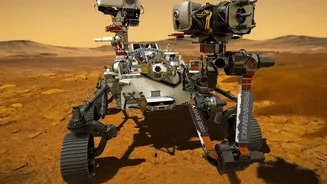


For years, the Perseverance rover has been drilling and storing precious rock samples on Mars, a treasure trove that could answer if life ever existed on the Red Planet. Now, NASA has a new strategy to bring them home.
The Priceless Cargo on Mars
Since its landing in February 2021,
NASA's Perseverance rover has been diligently working in Jezero Crater, an ancient lakebed considered a prime location to find signs of past microbial life. The rover is not just exploring; it's the first leg of one of the most ambitious robotic missions ever conceived: Mars Sample Return (MSR). Perseverance is collecting scientifically compelling samples of Martian rock, soil, and atmosphere, sealing them in ultra-clean titanium tubes. Some of these tubes have been cached in a depot on the surface, creating a backup supply, while others remain aboard the rover. Scientists believe that analyzing these samples in advanced laboratories on Earth is our best chance to unlock the secrets of Mars' geological history and definitively search for evidence of ancient life.
An Ambitious Plan Hits Reality
The original joint plan between NASA and the European Space Agency (ESA) was a multi-step marvel of engineering. It involved sending a lander to Mars, which would deploy a fetch rover to collect the sample tubes. A small rocket, the Mars Ascent Vehicle, would then launch these samples into orbit around Mars, where another spacecraft, the Earth Return Orbiter, would capture the container and fly it back to Earth. However, the immense complexity of this endeavor led to significant challenges. Independent reviews revealed that the mission's budget was spiraling, with estimates climbing from an initial $5.3 billion to a potential $8 to $11 billion. The timeline also slipped, with one NASA assessment suggesting a return date as late as 2040 under expected budgets, a delay the agency deemed unacceptable.
A New Path Forward: The PSRA
In response to these cost and schedule overruns, NASA has initiated a strategic reset. On November 9, 2026, the agency announced the Perseverance Sample Retrieval Architecture, or PSRA. This new initiative is not a mission plan itself, but a formal process to develop a new, more achievable strategy. A dedicated PSRA team will kick off its work in January 2027 with a mandate to develop impartial recommendations for a revised mission architecture. The team will assess mission requirements, review lessons learned from the previous MSR planning, and evaluate all current capabilities and acquisition options to find a more efficient and affordable path forward. This signals that NASA remains committed to the high-priority goal of returning the samples, but recognizes that a more streamlined approach is necessary to make it a reality.
The Race Against Time and Rival Missions
The PSRA team is expected to deliver its final report in the winter of 2027–2028, outlining a new blueprint for bringing the Martian rocks home. While one previous estimate suggested a revised plan could potentially return samples by 2035 for around $8 billion, the new review will determine the official path forward. This reassessment is happening under the shadow of a new space race. China is moving forward with its own ambitious Mars sample return mission, Tianwen–3, which aims to launch around 2028 and return samples to Earth as early as 2031. This adds a geopolitical dimension to NASA's efforts, creating external pressure to finalize a workable plan and get it funded. The ultimate goal remains the groundbreaking science these samples promise, a reward that multiple space agencies now have in their sights.