


A Steamy World 98 Light-Years Away
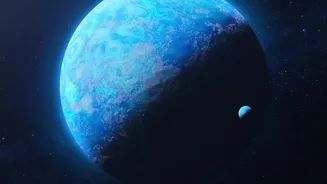
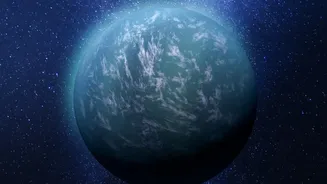
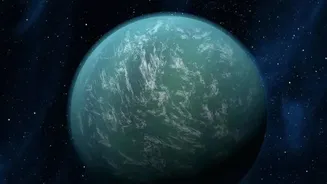
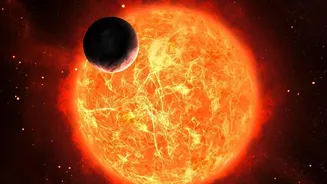
The latest breakthrough centres on a planet named GJ 9827 d, located about 98 light-years from Earth in the constellation Pisces. This isn't an Earth-twin; it's about twice our planet's diameter and is classified as a sub-Neptune. Using its advanced instruments,
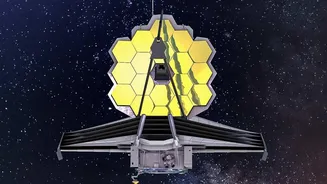
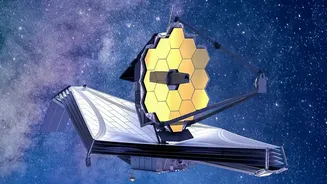
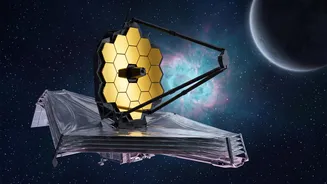
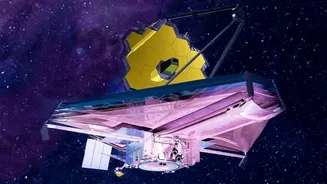
the James Webb Space Telescope (JWST) confirmed the presence of a substantial amount of water vapour in its atmosphere. Initial observations from the Hubble Space Telescope had hinted at water, but Webb's superior power has provided a much clearer picture. This makes GJ 9827 d the smallest exoplanet to date where we have a confirmed, detailed look at a water-rich atmosphere, a landmark discovery that pushes us closer to characterising potentially Earth-like worlds. It represents a huge step in the study of smaller, rocky or semi-rocky planets beyond our solar system.
How Webb Reads an Alien Atmosphere
How can a telescope detect atmospheric composition from nearly 100 light-years away? The answer lies in a technique called transmission spectroscopy. As an exoplanet passes in front of its host star from our point of view, a tiny fraction of the starlight filters through the planet's atmosphere. Different gas molecules in that atmosphere absorb specific wavelengths, or colours, of light. The result is like a cosmic barcode. JWST’s sensitive infrared instruments, particularly the Near-Infrared Imager and Slitless Spectrograph (NIRISS), can read this barcode. By analysing which colours of light are missing, astronomers can determine precisely which elements and molecules, like water vapour, methane, or carbon dioxide, are present. Before Webb, many such attempts resulted in flat, featureless readings, possibly due to thick clouds obscuring the view. Webb’s power allows it to peer through these hazy layers and capture an unprecedented level of detail.
The Magic of Infrared Light
The key to this capability is Webb’s specialisation in infrared light. Unlike visible light, which is easily scattered by dust and clouds, infrared wavelengths can pass through more easily, giving scientists a clearer view. Webb's primary instruments, such as the Near-Infrared Spectrograph (NIRSpec) and the Mid-Infrared Instrument (MIRI), are specifically designed to operate in this part of the spectrum. This is crucial because many important molecules, including water, have their strongest and most distinct absorption signatures in the infrared range. In essence, while Hubble gave us stunning views in visible light, Webb is giving us an entirely new sense, allowing us to perceive the chemical makeup of distant worlds in a way that was impossible before. This infrared vision is what allows Webb to fulfill one of its primary missions: the characterisation of exoplanet atmospheres.
Not a Second Earth, But Still Extraordinary
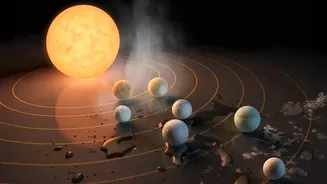
While finding water is exciting, it's important to manage expectations. GJ 9827 d is not a habitable paradise. The planet is scorching hot, with temperatures reaching around 425 degrees Celsius — as hot as Venus. At this temperature, any water would exist as a thick, oppressive steam. Scientists have two main theories about this world. It could be a 'mini-Neptune' that still has a puffy, hydrogen-rich atmosphere laced with water. Alternatively, it might be a true 'steam world,' a new type of planet where a rocky core is enveloped in a dense atmosphere made almost entirely of water vapour. The planet is so close to its star that the powerful radiation likely boiled away lighter elements like hydrogen and helium over time, leaving the heavier water molecules behind. So while you wouldn't want to visit, its existence confirms that planets with water-rich atmospheres can and do exist around other stars.
A New Chapter in Cosmic Exploration
The discovery of water on GJ 9827 d is more than just an inventory of a single planet; it is a profound proof of concept. It demonstrates that the James Webb Space Telescope has the power to do exactly what it was built for: to take us from simply finding exoplanets to truly understanding them. Each detection of an atmospheric component on a distant world refines our models of how planets form and evolve. Scientists can now compare the elements on a planet to its parent star to piece together its history. This finding is a milestone on the road to eventually analysing smaller, rocky planets within the habitable zones of their stars, where liquid water could exist. The detection of water is no longer a matter of pure luck or speculation; it is becoming a systematic science, paving the way for the ultimate search for a world that looks a little more like home.