
For decades, we've understood the universe to be about 13.8 billion years old. But what if it's actually twice that age? A new theory proposes just that, offering solutions to some of cosmology's most stubborn puzzles.
Our Universe's Standard Age
The prevailing scientific consensus,
known as the Lambda-CDM model, has been remarkably successful. It tells us the universe began with the Big Bang and has been expanding for approximately 13.8 billion years. This age is calculated by measuring the expansion rate of the cosmos and studying the oldest light we can see, the cosmic microwave background (CMB), which is a faint glow left over from about 380,000 years after the Big Bang. This model powerfully explains the universe's large-scale structure and the abundances of light elements like hydrogen and helium. However, it relies on two mysterious components, dark matter and dark energy, which are thought to make up 95% of the cosmos but have never been directly detected.
A Radical New Timeline
Now, a theory proposed by University of Ottawa physicist Rajendra Gupta and his colleagues challenges this long-held number. Their model, called CCC+TL (Covarying Coupling Constants plus Tired Light), calculates the universe's age to be 26.7 billion years. This isn't just a minor tweak; it fundamentally alters our cosmic history. The theory revives and combines two older ideas. The first is 'tired light', a concept proposed by Fritz Zwicky in 1929, which suggests that light loses energy as it travels across vast cosmic distances, making distant objects appear redder than they are. The second idea is that 'coupling constants'—fundamental forces of nature—might change over time. By merging these concepts with the expanding universe, the model proposes a new way to interpret the redshift of distant galaxies, which astronomers use to measure cosmic distance and time.
Solving Cosmic Puzzles
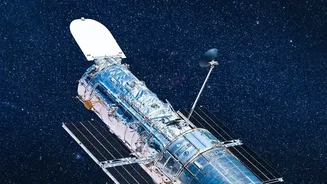
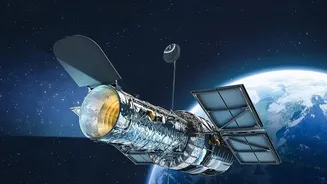
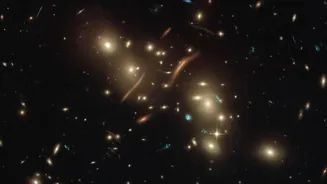
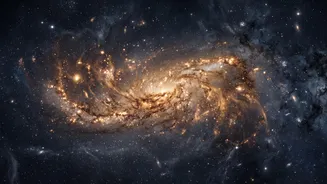
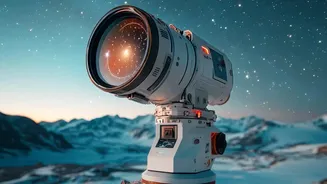
A nearly 27-billion-year-old universe might sound strange, but it offers elegant solutions to some baffling problems. The most significant is the 'impossible early galaxy problem'. The James Webb Space Telescope (JWST) has discovered galaxies that appear surprisingly massive and mature just a few hundred million years after the Big Bang. Under the standard 13.8-billion-year model, there simply wasn't enough time for them to grow so large and complex. Gupta's model extends the timeline for galaxy formation by billions of years. In this older universe, those 'impossible' galaxies become entirely predictable, as they had much more time to develop. This new model also potentially does away with the need for dark matter and dark energy, instead attributing their observed effects to the changing physical constants over cosmic time.
Rethinking the Rules of Physics
The CCC+TL model is more than just a new age; it suggests the fundamental rules of the cosmos may not be so constant after all. The theory proposes that constants governing forces like gravity and electromagnetism could have varied over time. This is a profound departure from the standard model, where these values are considered fixed. By allowing these constants to evolve, the model can explain the accelerated expansion of the universe without invoking dark energy. Similarly, the gravitational effects within galaxies, usually attributed to invisible dark matter, could instead be explained by these evolving forces. The 'tired light' component adds another layer, suggesting the redshift we observe from distant galaxies is a hybrid effect of both cosmic expansion and light losing energy on its journey to us.
A Debate Just Beginning
It is crucial to understand that the 26.7-billion-year-old universe is a provocative new idea, not an accepted fact. The Lambda-CDM model remains the bedrock of modern cosmology because it successfully explains a vast range of observations. Critics of tired light theories have pointed out that they have historically failed to explain phenomena like the precise blackbody spectrum of the cosmic microwave background or the observed time dilation in distant supernovae. Proponents of the new CCC+TL model argue their hybrid approach can match these observations while also solving the early galaxy problem. For now, it is a compelling alternative that provides testable predictions. As scientists gather more data from telescopes like the JWST, they will be able to further scrutinise both the standard model and this intriguing challenger, pushing our understanding of the universe's true age and origin.