




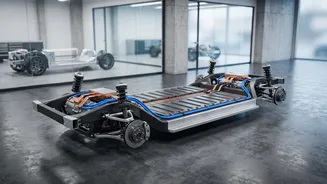
The Core Problem with EV Batteries Today
Electric vehicles are powered by large battery packs, and for years, the undisputed king of battery chemistry has been lithium-ion. It's in your phone, your laptop, and nearly every EV on the road. But this dominance comes with significant challenges.
Lithium is a relatively rare resource, with mining concentrated in a few countries. This creates a volatile supply chain, subject to geopolitical tensions and dramatic price swings. Furthermore, many lithium-ion batteries rely on other costly and ethically problematic materials like cobalt and nickel, whose mining is linked to environmental and social concerns. These factors directly contribute to the high sticker price of EVs, keeping them out of reach for a large segment of the Indian market.
Enter Sodium-Ion: The Abundant Alternative
Sodium-ion batteries work on a very similar principle to their lithium-ion cousins, but they swap out lithium for sodium as the key ingredient. The primary advantage here is staggering: sodium is one of the most abundant elements on Earth, readily available everywhere from seawater to common table salt. This incredible abundance means the raw materials are dramatically cheaper and the supply chain is far more stable and secure. Estimates suggest that once manufacturing is scaled up, sodium-ion batteries could be 20-30% more economical than current lithium-ion technologies. By designing out expensive materials like lithium and cobalt, the technology strikes at the very heart of what makes EVs expensive.
More Than Just Cheaper, It's Greener
The 'sustainable' part of the promise goes beyond just cost. The extraction of sodium is significantly less impactful on the environment compared to the water-intensive and often destructive process of lithium mining. While no manufacturing process is without its footprint, sodium-ion technology avoids many of the biggest environmental and ethical headaches associated with lithium-ion batteries. Researchers note that the overall climate impact is equivalent to lithium-ion, but without the risk of depleting scarce mineral resources. However, for this to be a truly 'green' alternative in the long run, a robust recycling infrastructure will need to be developed, as the technology is still in the early stages of commercialisation.
Is It Good Enough for Indian Roads?
The biggest trade-off with sodium-ion technology has historically been its lower energy density. This means that for the same weight, a sodium-ion battery stores less energy than a lithium-ion one, resulting in a shorter driving range. While this makes it less suitable for long-range luxury EVs, it's a perfect fit for the mass-market segment in India: smaller city cars, two-wheelers, and three-wheelers where daily travel distances are shorter and affordability is paramount. Furthermore, sodium-ion batteries have a key advantage for Indian conditions: superior safety and thermal stability. They are less prone to overheating and fire, a crucial benefit in a country with extreme temperatures. They also perform better in the cold than many lithium-ion variants.
The Race to Commercialisation
This technology is no longer confined to the lab. Global battery giants like CATL and BYD are already beginning mass production, with the first sodium-ion powered EVs hitting the streets in China in 2026. In India, major players are also investing heavily. Reliance Industries acquired the UK-based sodium-ion pioneer Faradion and plans to leverage the technology in its gigafactory. Other Indian companies like KPIT Technologies and Naxion Energy are also active in the space, supported by government interest in diversifying the battery supply chain away from import dependency. While the technology is still maturing, the path to commercial rollout in entry-level vehicles over the next few years seems clear.