


A Blueprint for Habitability
When astronomers scan the skies for exoplanets, they aren't just looking for any random rock; they're looking for worlds with conditions that might support life as we know it. Earth serves as the ultimate template. By studying our own planet, scientists
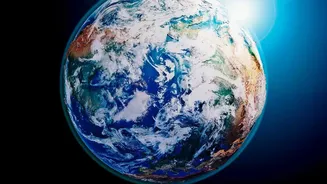
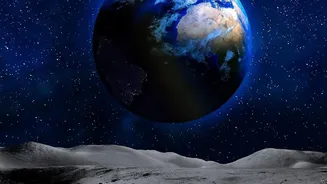
can create a checklist for habitability: the presence of liquid water, a protective atmosphere, and a stable climate within a star's 'habitable zone'. This zone is the orbital region where conditions are just right for liquid water to exist on a planet's surface. However, treating Earth as a far-off exoplanet allows scientists to test their methods. They can analyze Earth's reflected light and atmospheric composition as if it were a distant dot, helping to refine the very techniques used to study worlds light-years away. It’s like having the answer key to the test before you take it, ensuring that when we do find a promising candidate, we know how to interpret the data.
Life at the Extremes
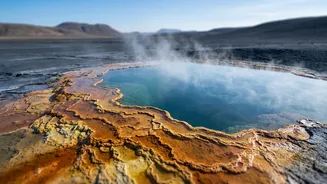
For a long time, the search for life was limited by our own biological comfort zone. But the discovery of 'extremophiles' on Earth has dramatically expanded our imagination. These are organisms that thrive in environments we once considered lethal: boiling hot springs, acidic waters, deep-sea vents without sunlight, and even within salt crystals and nuclear reactors. From microbes in the freezing permafrost of the Arctic to the famed tardigrades that can survive the vacuum of space, these resilient life forms prove that biology is far more tenacious than we ever believed. By studying extremophiles, scientists can establish the absolute limits of Earth-like life. This knowledge helps astrobiologists identify other locations in our solar system, like the subsurface oceans of Jupiter's moon Europa or Saturn's moon Enceladus, as potential habitats for life, even if they seem inhospitable on the surface.
A Journey into Deep Time
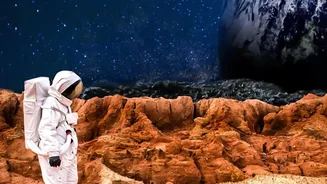
Modern Earth, with its oxygen-rich atmosphere and sprawling forests, is just one snapshot in a 4.5-billion-year history. For much of its existence, our planet would have looked completely alien. By studying Earth's geological past, scientists can understand what a young, living planet might look like. For billions of years, life on Earth was purely microbial, and the atmosphere was anoxic, or lacking in oxygen. If we only searched for planets with atmospheres like ours today, we might miss worlds that are in an earlier stage of biological evolution. Studying rock records and ancient climates provides a 'template' for different evolutionary stages, from a world dominated by simple mosses to one covered by ferns. This historical perspective allows scientists to model how a planet's 'biosignatures'—the chemical fingerprints of life—change over geological time.
Decoding Alien Atmospheres
Perhaps the most crucial role Earth plays is helping us identify what signs of life, or biosignatures, actually look like from a distance. A biosignature is any substance, phenomenon, or pattern that provides evidence of past or present life. When a telescope like the James Webb Space Telescope analyzes an exoplanet's atmosphere, it's looking for specific chemical imbalances that are hard to explain without biology. On Earth, the simultaneous presence of oxygen and methane is a strong indicator of life, as these gases would normally react with and destroy each other. Their persistent coexistence points to them being constantly replenished by biological processes like photosynthesis and microbial activity. Without Earth as a reference, we wouldn't know that this specific chemical cocktail screams 'life'. As our tools get more sophisticated, we are learning to spot other potential signs, from specific light signatures reflected by vegetation to complex organic molecules.