


A System of Superlatives
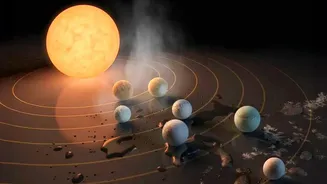
Ever since its discovery was announced in 2017, the TRAPPIST-1 system has captured the imagination of scientists and the public alike. It holds the record for the most Earth-sized rocky planets found orbiting a single star. Seven of them, all huddled
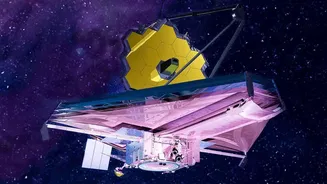
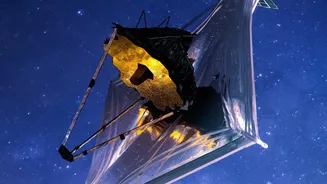
close to their small, cool red dwarf star. At least three of these planets orbit within the so-called “habitable zone,” the region where temperatures could theoretically allow liquid water to exist on a planet's surface. This made the system a perfect laboratory for the James Webb Space Telescope (JWST) to investigate. For years, astronomers have dreamed of peering into the atmospheres of these worlds, searching for the chemical building blocks of life. Now, that dream is becoming a reality, though the findings are proving to be more complex and challenging than many had hoped.
Webb's Unblinking Gaze
The JWST doesn't observe these distant planets directly like a camera taking a portrait. Instead, it uses a technique called transmission spectroscopy. As a planet passes in front of its star from our point of view, a tiny fraction of the starlight filters through the planet's atmosphere. Different gases in that atmosphere absorb specific wavelengths, or colours, of light, leaving a unique chemical fingerprint on the starlight that reaches the telescope. By analysing this filtered light, astronomers can deduce which molecules are present. For the TRAPPIST worlds, the key target has always been to see if they have atmospheres at all, and if so, whether they contain water, methane, or carbon dioxide—gases that play critical roles in the habitability of our own planet.
A Thick Blanket of Carbon
The latest data from Webb has focused on the inner planets of the system, specifically TRAPPIST-1b and TRAPPIST-1c. The headline finding indicates the presence of a significant amount of “heavy carbon gas,” which in astronomical terms points to a dense atmosphere rich in carbon dioxide (CO2). Previous studies had suggested that TRAPPIST-1c, in particular, could be a “Venus twin,” potentially possessing a thick CO2 atmosphere. While the presence of an atmosphere is exciting, the sheer volume of CO2 detected paints a complicated picture. This isn't the gentle, life-sustaining blanket of gas we have on Earth. Instead, it suggests an environment that may be far more hostile, fundamentally altering the prospects for habitability on these specific worlds.
Too Much of a Good Thing?
On Earth, carbon dioxide is a vital greenhouse gas, trapping heat and keeping our planet warm enough for liquid water and life. But there can be too much of a good thing. A planet with a runaway greenhouse effect, like Venus in our own solar system, has an atmosphere so thick with CO2 that it traps an enormous amount of heat, boiling away any oceans and rendering the surface utterly inhospitable. The high concentration of CO2 suggested by the JWST data for the inner TRAPPIST planets points towards a similar scenario. It suggests they are not Earth-like worlds with temperate climates, but are more likely scorching, high-pressure environments. The intense radiation from the parent star, a common feature of red dwarf systems, may have stripped away lighter elements and water vapor long ago, leaving behind a heavy, dense blanket of CO2.
The Search Continues
While this news might seem disappointing for those hoping for an Earth 2.0 in the TRAPPIST system, it is a monumental scientific achievement. It proves that the JWST can detect and characterise the atmospheres of Earth-sized, rocky planets 40 light-years away—a feat that was impossible just a few years ago. Furthermore, the TRAPPIST system has more planets to explore. Observations are ongoing for the outer planets like TRAPPIST-1d, 1e, and 1f, which are further from the star and could have retained different types of atmospheres. Studies of TRAPPIST-1e, for example, have already ruled out a thick CO2 atmosphere, leaving open the possibility of a different composition. Each piece of data, whether it reveals a potential haven or a barren rock, refines our understanding of how planets form and evolve, and where the best places to search for life truly are.