





What Exactly is a Kettlebell Flow?
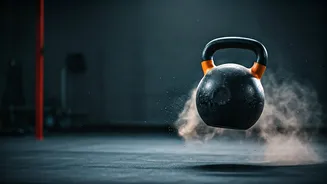
Forget the stop-start rhythm of traditional sets and reps. A kettlebell flow is a sequence of different exercises chained together into one seamless, graceful, and powerful movement. You move from one exercise to the next without putting the kettlebell down.
Think of it as a form of strength-based dance. For example, you might transition from a swing directly into a clean, then into a squat, and finally into an overhead press, all in one fluid motion. The goal isn't just to lift the weight, but to control its momentum as it moves through different planes of motion. This constant tension and movement builds incredible endurance, coordination, and real-world strength that isolated exercises can't replicate.
The Power of Explosive Hip Drive
The secret to the power-building magic of kettlebell flows lies in one key biomechanical action: the hip hinge. Movements like the swing, clean, and snatch aren't arm exercises; they are full-body expressions of power generated from your hips and glutes. By explosively driving your hips forward, you generate immense force that travels up through your core and propels the kettlebell. This mimics the fundamental movements of almost every sport—jumping, sprinting, and throwing. Training this explosive hip drive not only makes you more powerful in the gym but also translates directly into better athletic performance and a reduced risk of lower back injury in daily life, as you learn to lift with your legs and glutes instead of your spine.
The Core Movements to Master
To build an effective flow, you first need to master the individual components. Focus on perfect form with a light weight before you even think about stringing them together. 1. **The Kettlebell Swing:** The foundation of all explosive kettlebell work. Stand with feet shoulder-width apart, hinge at your hips (push your butt back), and grip the kettlebell with both hands. Hike it back between your legs, then explosively drive your hips forward, squeezing your glutes to propel the bell to chest height. The movement should be sharp and powerful, not a lazy lift. 2. **The Kettlebell Clean:** This movement brings the kettlebell from the floor or a swing into the 'rack' position (resting on your forearm, tucked into your chest). It’s a powerful hip snap, similar to a swing, but you keep the bell close to your body, pulling your elbow back and allowing the bell to roll gently over your wrist. A proper clean is quiet and smooth, not a crash landing on your arm. 3. **The Kettlebell Press (or Push Press):** From the rack position, you can either do a strict press (using only your shoulder and arm strength) or a push press for more explosive power. For a push press, dip slightly at the knees and then drive upwards, using the power from your legs to help launch the kettlebell overhead to a stable, locked-out position.
Building Your First Morning Flow
Now, let's put it all together. A simple yet brutally effective flow is the 'Swing-Clean-Press'. Here’s how to perform it on one side before switching to the other. 1. Start with a single-arm **Swing**. 2. At the top of the next swing, transition it into a **Clean**, bringing the bell smoothly into the rack position. 3. From the rack, perform one **Press** or **Push Press** overhead. 4. Lower the bell safely back to the rack, then down into the next swing. That entire sequence is one repetition. Aim for 3-5 reps on one arm, then switch arms and repeat. Perform 3-4 total sets with about 60-90 seconds of rest in between. The goal is quality over quantity. Each rep should feel powerful and controlled. This short routine is perfect for the morning as it fires up your central nervous system, gets your heart rate up, and activates nearly every muscle in your body, leaving you feeling powerful and ready for the day.
Warm-Up and Safety First
Never jump into an explosive workout cold, especially in the morning. Your body needs to be prepared for dynamic movement. Spend 5-10 minutes on a proper warm-up. Start with light cardio like jumping jacks or jogging on the spot to raise your body temperature. Follow this with dynamic stretches that mimic the movements you're about to perform. Focus on hip circles, leg swings (forward and side-to-side), torso twists, and a few sets of bodyweight squats and glute bridges. Finally, perform a few reps of each individual kettlebell movement with a very light weight to prime the specific motor patterns before you start your flow.