
What Exactly Is a Brown Dwarf?
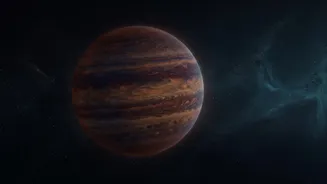
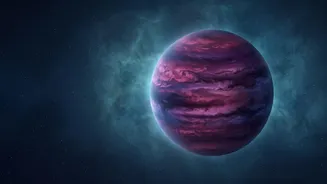
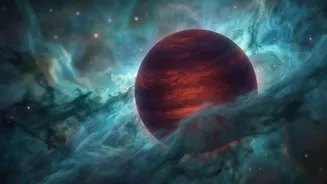
A brown dwarf is an object that occupies the fascinating grey area between a planet and a star. Often called 'failed stars', they form in much the same way as their stellar siblings do: from the gravitational collapse of a giant cloud of gas and dust.
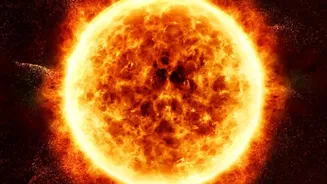
However, they never accumulate enough mass to kickstart the sustained hydrogen fusion in their core that makes a star shine. While they are far more massive than any planet—typically ranging from 13 to 80 times the mass of Jupiter—they lack the gravitational oomph to become a true star. They do get hot enough to glow dimly, mostly in the infrared spectrum, and can even fuse a heavier type of hydrogen called deuterium for a short period early in their lives before they begin a long, slow cooldown.
A Bridge Between Stars and Planets
This 'in-between' status is precisely what makes brown dwarfs so valuable to astronomers. They serve as a crucial bridge, helping scientists refine the very definitions of 'star' and 'planet'. By studying where the life of a brown dwarf begins and a small star ends, researchers can better understand the minimum requirements for star birth. The process is similar: a cloud collapses, a core forms, and material is accreted. For brown dwarfs, that process just stops short. This allows scientists to probe the lower limits of star formation, asking fundamental questions about how small a star can possibly be. Studying these objects helps clarify the branching paths an interstellar gas cloud can take: one leading to a brilliant, long-lived star, and the other to a dim, fading brown dwarf.
An Unexpected Laboratory for Planet Formation
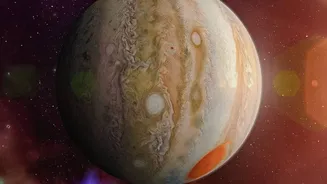
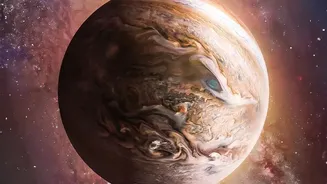
Beyond stars, brown dwarfs also offer a unique perspective on the formation of planets. Since many brown dwarfs drift through space alone, they are easier to study in detail than a planet that is lost in the blinding glare of its host star. The atmospheres of brown dwarfs can be surprisingly similar to those of gas giants like Jupiter, complete with clouds and powerful storms, making them excellent stand-ins for studying planetary weather. Furthermore, astronomers have discovered that some brown dwarfs are surrounded by their own protoplanetary disks—the same swirling rings of gas and dust from which planets form around stars. This suggests that planetary systems can form even around these tiny, dim objects, providing a completely new and different environment to test theories of how worlds are made.
Finding a Needle in a Cosmic Haystack
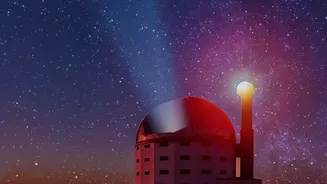
Because they are so dim and cool, finding brown dwarfs is a significant technological challenge. They barely emit any visible light, meaning they can only be detected by powerful infrared telescopes that can see the faint heat they radiate. Observatories like NASA's James Webb Space Telescope (JWST) and the now-retired Spitzer Space Telescope are perfectly suited for this task, able to peer into the infrared universe and spot these faint wanderers. Recent findings from missions like SPHEREx are analyzing thousands of these objects, revealing rich details about the molecules in their atmospheres, such as methane and carbon dioxide. Each new discovery helps astronomers build a more complete census of our galaxy, revealing just how common these celestial misfits might be.
Recent Discoveries and Future Mysteries
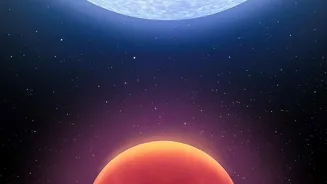
The study of brown dwarfs is a dynamic field, with new discoveries constantly reshaping our understanding. Recently, in late 2026, astronomers observed a star in the process of slowly 'snacking' on a companion brown dwarf. This slow, steady cannibalism is a newly observed phenomenon that reveals an alternative to the usual dramatic engulfment of a smaller body by a star, and it could last for billions of years. These kinds of findings show that the interactions between stars and their companions are more complex than previously thought. As technology improves, astronomers will continue to uncover more of these hidden objects, using them to piece together the grand narrative of how stars are born, how planets form around them, and how these systems evolve across cosmic timescales.