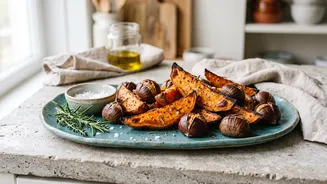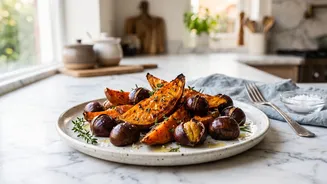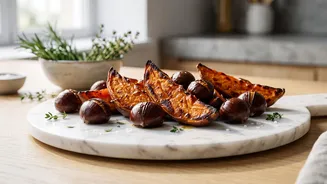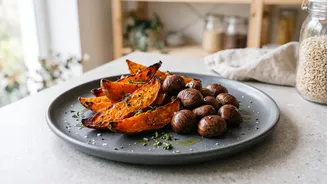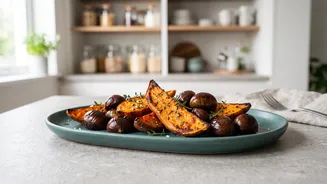







As the weather cools, two seasonal favourites often appear on our plates: sweet potatoes and chestnuts. Both are delicious and comforting, but which one is the healthier choice? The answer isn't a simple one, as the real secret lies in the details.
The Calorie and Carb Question
When
comparing these two foods gram for gram, a surprising fact emerges. Roasted chestnuts are significantly more calorie-dense than sweet potatoes. A 100-gram serving of roasted chestnuts contains around 245 calories and 53 grams of carbohydrates. In contrast, the same amount of baked sweet potato has only about 86 calories and 20 grams of carbohydrates. This makes sweet potato the lighter option if you're watching your calorie intake. The reason for this difference is that chestnuts are nutritionally unique; they are starchy like a grain but are technically a nut, albeit one with very low fat content compared to others like almonds or walnuts.
A Tale of Two Vitamin Profiles
This is where the two foods really diverge and show their individual strengths. Sweet potatoes are famous for their incredibly high vitamin A content, thanks to beta-carotene, the compound that gives them their orange hue. A single medium sweet potato can provide well over 100% of your daily recommended intake of vitamin A, which is crucial for vision and immune function. Chestnuts, on the other hand, offer a unique benefit among nuts: a significant amount of vitamin C. While most nuts contain almost none, a 100-gram serving of chestnuts can provide a substantial portion of your daily vitamin C needs, an antioxidant important for skin health and immune defence. Chestnuts also provide B vitamins, which are important for brain health.
Fibre, Fat, and Blood Sugar
Both foods are good sources of dietary fibre, which aids digestion and helps you feel full. Chestnuts have a slight edge, with about 8 grams of fibre per 100g compared to the 3-4 grams in sweet potato. When it comes to fat, both are very low-fat foods. Perhaps most importantly for many, we need to consider the glycemic index (GI), which measures how quickly a food raises blood sugar. Here, preparation is everything. Boiled sweet potatoes have a low-to-medium GI (around 44-61), making them a good choice for steady energy. However, baking a sweet potato can cause its GI to spike as high as 94. Chestnuts have a relatively low GI of around 54, meaning they provide a slower, more sustained release of energy.
Why Portion Size is Everything
This brings us to the most critical point: portion control. Because chestnuts are more caloriend carbohydratendense, it's easier to overdo it. A healthy portion is considered to be about a handful, or around 10 kernels, which comes in at roughly 206 calories. For sweet potato, a standard portion is one mediumstized tuber, which provides around $100-$130 calories. While a single sweet potato makes a filling side dish, eating the equivalent volume of chestnuts would mean consuming significantly more calories. The key is to treat chestnuts as a starchy snack and sweet potatoes as a vegetable component of a meal, being mindful of the quantity in both cases.
The Verdict: Room for Both on Your Plate
There is no definitive 'winner' in the battle between sweet potatoes and chestnuts. Each offers a unique nutritional package. Sweet potatoes are an unparalleled source of vitamin A and are lower in calories, making them an excellent, nutrient dense vegetable. Chestnuts stand out for their vitamin C and fibre content, providing a satisfying, low fat snack unlike other nuts. The choice depends on your dietary needs and goals. If you need a powerful vitamin A boost, reach for a sweet potato. If you want a gluten free, grain like carbohydrate source that's also rich in vitamin C, chestnuts are a fantastic option. The most important takeaway is that both can be part of a healthy diet when eaten in moderation and prepared wisely, such as by boiling sweet potatoes to maintain a lower GI or roasting chestnuts without added fats or sugars.