
India's Next Interplanetary Frontier
Building on the monumental successes of the Chandrayaan and Mangalyaan missions, the Indian Space Research Organisation (ISRO) is embarking on its next great adventure into the cosmos. The Shukrayaan mission, formally known as the Venus Orbiter Mission,
represents a logical and ambitious next step in India’s planetary exploration programme. After demonstrating its capabilities with missions to the Moon and Mars, ISRO has now set its sights on unraveling the secrets of the second planet from the Sun. The Union Cabinet approved the mission in September 2024, with a targeted launch date of March 29, 2028. The spacecraft is expected to be launched aboard the powerful LVM-3 rocket, the same launch vehicle that successfully carried Chandrayaan-3. This mission underscores India’s growing prowess and commitment to expanding humanity's understanding of our solar system.
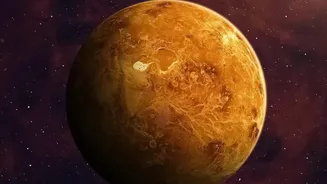
The Enigma of Planet Venus
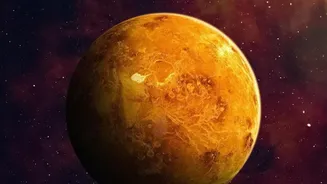
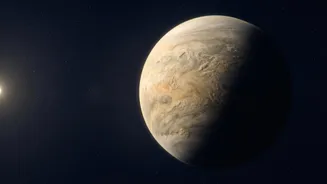
Venus is often called Earth's twin due to its similar size and mass, but it couldn't be more different. It is arguably the most hostile planet in the solar system. Its surface is a scorching hellscape with temperatures hot enough to melt lead, reaching around 475°C. The atmospheric pressure is over 90 times that of Earth's at sea level, equivalent to the crushing pressure found nearly a kilometer deep in our oceans. To make matters worse, the planet is perpetually shrouded in thick, opaque clouds of sulfuric acid. This dense carbon dioxide atmosphere has created a runaway greenhouse effect, a cautionary tale for what can happen to a planet's climate. Understanding why Earth's twin had such a divergent evolutionary path is one of the biggest questions in planetary science.
Peering Beneath the Clouds
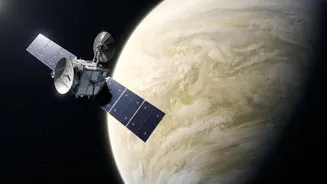
The primary goal of the Shukrayaan mission is to do what has been so difficult for decades: to study the Venusian surface and atmosphere in detail. The 2,500 kg orbiter will be placed in a large elliptical orbit, eventually using aerobraking to settle into a lower, more optimal orbit for scientific observation. Its key objectives include investigating the planet’s surface and shallow subsurface. It will also analyze the structure and composition of its dense atmosphere, including the mysterious super-rotating winds that spin much faster than the planet itself. Furthermore, Shukrayaan will examine the interaction between the Venusian ionosphere and the solar wind, which is crucial for understanding how the planet lost its water over billions of years.
A Toolkit for a Hostile World
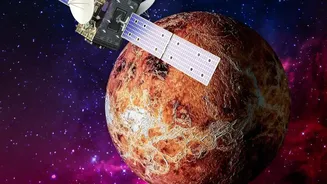
To achieve its ambitious goals, Shukrayaan will be equipped with a suite of sophisticated instruments weighing approximately 100 kg. The flagship instrument is a high-resolution Synthetic Aperture Radar (SAR), designed to penetrate the thick cloud cover and map the planet's surface in unprecedented detail, with a resolution expected to be significantly higher than NASA's Magellan mission from the 1990s. The mission is also slated to carry a ground-penetrating radar, which would be a first for Venus exploration, allowing scientists to study the subsurface stratigraphy. Other payloads, including some developed in collaboration with international partners from Sweden, Russia, and Germany, will study volcanic hotspots, analyze atmospheric gases, and monitor cloud movements and lightning.
A New Era of Venus Exploration
ISRO's Shukrayaan mission is part of a renewed global interest in Venus. For decades, Mars has received the lion's share of attention, but scientists are once again turning their focus to Earth's shrouded twin. NASA is preparing its own ambitious missions, VERITAS and DAVINCI+, and Russia has proposed the Venera-D mission. India's contribution is considered highly significant because multiple, independent missions observing the planet from different vantage points and with complementary instruments can generate a much more comprehensive understanding. This collaborative, multi-mission approach promises to finally lift the veil on Venus, revealing secrets about its geological evolution, climate history, and why it became so inhospitable while its twin, Earth, flourished with life.