






The Martian Air Problem
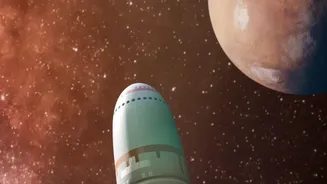
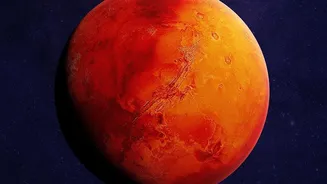
Landing humans on Mars is one of the great goals of the 21st century, but survival there presents immense challenges. Chief among them is the atmosphere. The air on Mars is about 100 times thinner than Earth's and is composed of 95% carbon dioxide (CO2),
with only a tiny fraction (0.13%) of oxygen. For comparison, the air we breathe on Earth contains about 21% oxygen. This means that without a spacesuit, an astronaut would not be able to breathe. Simply trucking all the necessary oxygen from Earth is not a viable long-term solution. A mission to Mars would require tonnes of oxygen not just for breathing, but also as a critical component of the rocket propellant needed for the return journey. The cost and logistical complexity of launching that much oxygen from Earth make it almost prohibitive. The solution, therefore, is to 'live off the land' by making oxygen on-site, a process known as In-Situ Resource Utilization (ISRU).
A Toaster That Makes Oxygen
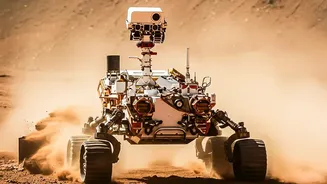
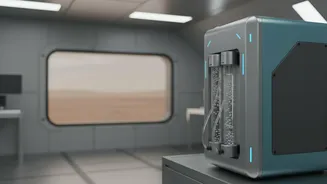
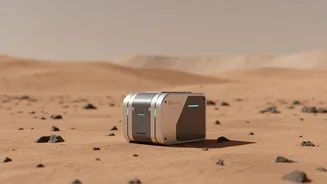
The first major breakthrough in this area came from a toaster-sized instrument aboard NASA's Perseverance rover. The Mars Oxygen In-Situ Resource Utilization Experiment, or MOXIE, was designed to prove that extracting oxygen from the Martian atmosphere was possible. It works through a process called solid oxide electrolysis. MOXIE draws in the Martian air, heats it to around 800 degrees Celsius, and then uses an electrochemical process to split the carbon dioxide molecules into oxygen and carbon monoxide. Between 2021 and 2023, MOXIE successfully ran 16 times, producing a total of 122 grams of high-purity oxygen. While that’s only enough to keep a small dog breathing for about ten hours, it was a landmark achievement. It proved definitively that the fundamental chemistry works in the harsh, real-world conditions of Mars.
Building a Better Reactor
MOXIE was a proof of concept, not a full-scale production system. The next challenge is to build a larger, more efficient, and more durable reactor. This is where scientists are now focusing their efforts. Teams are working on scaling up the technology significantly. For instance, since the original MOXIE was designed, newer variants of its Solid Oxide Electrolysis (SOXE) stacks have been developed that are over 30 times larger. Other improvements focus on durability and efficiency. One major issue is that the high-temperature electrolysis process can cause degradation, particularly the formation of solid carbon ('coking'), which can damage the machine. Researchers are now developing advanced materials, such as improved cathodes and oxidation-resistant perovskites, to create more robust cells that last longer and are less prone to this damage. These new designs aim to increase reliability and reduce the need for complex subsystems, which in turn lowers the overall mass that needs to be launched from Earth.
Oxygen from Ice and Plasma
Extracting oxygen from the air isn't the only option being explored. Mars has significant deposits of water ice, particularly at its poles. Some scientists are developing electrolyzers designed to split this water, which is often salty, into hydrogen and oxygen. An advantage of this method is that it also produces hydrogen, which can be used as a fuel source. One system developed by engineers at Washington University in St. Louis was shown to produce 25 times more oxygen than MOXIE for the same amount of power by working directly with salty water in simulated Martian conditions. Another alternative approach bypasses high-temperature electrolysis altogether, instead using low-temperature plasma to split CO2 molecules. This method could be more energy-efficient and faster to start up, making it well-suited to the fluctuating power supply from solar panels on Mars.