




Venus's Bizarre Clock
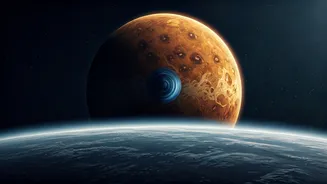
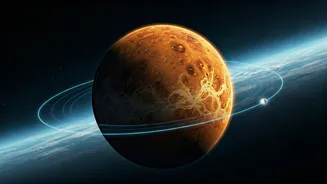
Let’s get the mind-bending numbers out of the way first. A year on Venus—the time it takes to complete one orbit around the Sun—is about 225 Earth days. This seems fairly normal. But its day is the real oddball. A single rotation on its axis, known as
a sidereal day, takes a staggering 243 Earth days. Yes, you read that right. The planet takes longer to spin once than it does to travel all the way around the Sun. This simple fact makes Venus unique in our solar system and turns our understanding of timekeeping on its head.
The Atmosphere as a Brake
So, what’s slamming the brakes on Venus? The primary culprit is its incredibly dense atmosphere. Venus is shrouded in a thick blanket of carbon dioxide, about 90 times denser than Earth's atmosphere. This creates an extreme greenhouse effect, but it also has a powerful physical influence on the planet itself. The Sun's intense radiation heats this soupy atmosphere, causing it to bulge and flow. This moving mass of gas, known as a 'thermal tide', drags against the planet's surface. Over billions of years, this atmospheric friction has acted like a colossal brake, slowing Venus's rotation down to its current, leisurely pace. It's as if the planet is trying to spin through cosmic treacle.
Spinning the Wrong Way
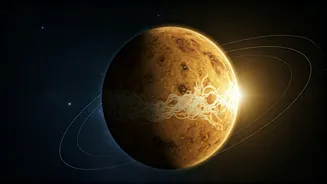
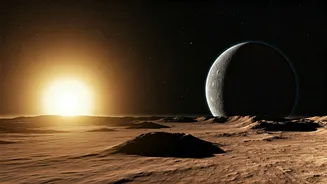
To make things even stranger, Venus spins backwards. While Earth and most other planets in our solar system rotate counter-clockwise, Venus has a 'retrograde' rotation, spinning clockwise. This has a curious effect on its solar day (the time from one sunrise to the next). Because the planet is slowly spinning in the opposite direction of its orbit, the sunrises are incredibly far apart. A solar day on Venus is about 117 Earth days long. So, while a rotational day is 243 Earth days, you’d only experience two sunrises in a Venusian year. Scientists believe this backward spin might be the result of a colossal impact with another planetary body deep in its history, which could have knocked it off-kilter and reversed its spin.
A World Without a Dynamo
This sluggish rotation has profound consequences for the planet as a whole. On Earth, our planet's relatively fast spin, combined with its molten iron core, creates a powerful magnetic field. This field, called the magnetosphere, acts as a shield, deflecting harmful solar wind and cosmic radiation. Venus, with its achingly slow spin, lacks this protective dynamo. Its core might be liquid, but it doesn't spin fast enough to generate a global magnetic field. This leaves its upper atmosphere exposed and vulnerable to being stripped away by the solar wind, contributing to its current barren, waterless state.
The Hellish Consequences
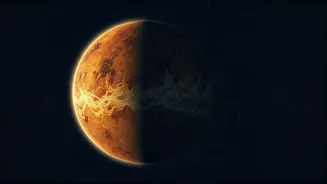
The slow rotation is a key ingredient in Venus’s hellish recipe. With a 'day' side exposed to the sun for months at a time and a 'night' side plunged into an equally long darkness, you might expect wild temperature swings. But the thick atmosphere is very good at distributing heat. It acts like a global blanket, trapping heat and moving it around so efficiently that there is very little temperature difference between day and night, or between the equator and the poles. This results in a stable, planet-wide surface temperature of around 465°C—hot enough to melt lead. The slow spin doesn’t cause this heat, but it helps create the stable, oven-like conditions that make Venus the most inhospitable planet in the solar system.