
A Messenger From Beyond
First, let's break down what an interstellar object is. Most comets and asteroids we see are local, born from the same cloud of gas and dust that formed our Sun and planets about 4.6 billion years ago. They are gravitationally bound to the Sun, following
predictable elliptical orbits. An interstellar object, however, is a tourist. It comes from a completely different star system, isn't bound by our Sun's gravity, and is just passing through. Comet 3I/ATLAS is only the third such visitor ever confirmed, following the strange, rocky object named 'Oumuamua in 2017 and another comet, 2I/Borisov, in 2019. Each one is a precious opportunity to study material from far away in the galaxy.
How We Know It's From Afar
The dead giveaway for an interstellar visitor is its path through space. Objects from our solar system travel in closed, elliptical orbits. Interstellar objects, however, travel so fast that the Sun's gravity can't capture them. They follow what's called a hyperbolic trajectory—a unique, open-ended path that proves they are just passing through. They enter our solar system, swing around the Sun, and head back out into deep space, never to return. Astronomers can calculate this trajectory with great precision, confirming that objects like 3I/ATLAS are not from around here. Its incredible speed is another clue; it's moving too fast to have originated in our solar system.
A Glimpse of Another World's Chemistry
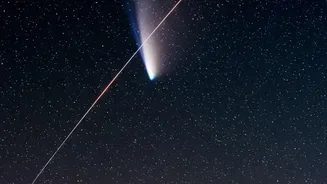
Unlike the first interstellar visitor, 'Oumuamua, which was rocky and didn't have a visible tail, 3I/ATLAS and its predecessor 2I/Borisov are more like classic comets. They are often described as 'dirty snowballs'—conglomerations of ice, dust, and frozen gases. As they get closer to the Sun, these ices heat up and turn directly into gas, creating a glowing atmosphere called a coma and often a spectacular tail. By using instruments called spectrographs, astronomers can analyse the light from this coma to figure out what it's made of. This is a game-changer because it allows scientists to directly measure the chemical 'recipe' of a planet-forming system other than our own. For instance, 2I/Borisov was found to have a surprisingly high concentration of carbon monoxide, suggesting it may have formed around a different type of star than our Sun.
Why These Visitors Are So Important
Studying interstellar comets like 3I/ATLAS is like receiving a free sample from another solar system. We can't travel to other stars, but these objects bring a piece of their home system to us. Comets are considered pristine leftovers from the time of planet formation. By studying their composition, we can learn about the raw materials that build planets in other parts of the galaxy. This helps us answer some of the biggest questions in science: Is our solar system typical? Are the building blocks for life common throughout the galaxy? Each interstellar object provides a new data point, revealing the diversity of planetary systems out there. The differences between 'Oumuamua, Borisov, and ATLAS show that other systems might build planets in ways very different from our own.
The Dawn of a New Era
For a long time, detecting an interstellar object was just a theoretical possibility. But thanks to powerful new telescopes and sky surveys, like the upcoming Vera C. Rubin Observatory, we are getting much better at spotting them. Astronomers now estimate that several interstellar objects may pass through our solar system each year, though most are too small or too far away to detect. With the ability to find more of these visitors, scientists will be able to build a library of samples from across the galaxy. This will revolutionise our understanding of how star systems form and evolve, and ultimately, will help us better understand our own cosmic origins.