








Cosmic Spinning Tops
At its heart, a pulsar is a type of neutron star, which is the incredibly dense remnant of a massive star that exploded in a supernova. Imagine something with more mass than our sun crushed into a sphere only about 20 kilometers across. A single teaspoon
of this material would weigh millions of tons. This extreme compression has a profound effect on its rotation. Due to the principle of conservation of angular momentum—the same reason a figure skater spins faster when they pull their arms in—the star's original slow rotation speeds up dramatically. The fastest known pulsars can spin over 700 times every second, faster than the blades of a household kitchen blender. This rapid spin is the first key ingredient that makes them so scientifically valuable.
Unimaginable Magnetic Power
The second crucial element of a pulsar is its mind-bogglingly strong magnetic field. As the star's core collapsed, its original magnetic field was compressed and amplified to an incredible degree. The result is a magnetic field that can be a trillion times stronger than Earth's. This magnetism is so powerful it would be a dangerous place for any traveler; it creates electric fields with over a trillion volts, capable of ripping nearby matter apart. This intense magnetic field doesn't align perfectly with the star's spin axis, much like how Earth's magnetic north pole is different from its geographic North Pole. This misalignment is the key to the pulsar's signature effect.
The Lighthouse Effect
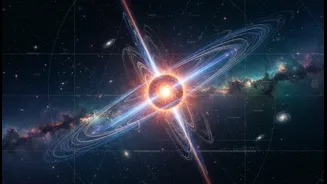
The combination of rapid rotation and a misaligned, ultra-strong magnetic field creates the 'lighthouse' effect that defines a pulsar. The magnetic field channels superheated particles into powerful beams of radiation that shoot out from the pulsar's magnetic poles. As the neutron star spins, these beams of energy—which can include radio waves, X-rays, and gamma rays—sweep across the cosmos like the rotating beam of a lighthouse. From our perspective on Earth, if one of these beams happens to sweep past us, our telescopes detect a regular, repeating pulse of energy. This is why they are called pulsars; they appear to 'pulse' on and off with a regularity so precise they are considered among the most accurate clocks in the universe.
Charting the Cosmic Beacons
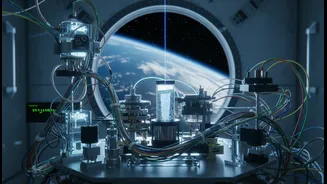
Recognizing the incredible stability of these cosmic clocks, NASA has been working on a way to use them for navigation. The concept isn't entirely new—a map of 14 pulsars was placed on the Voyager spacecraft in the 1970s as a guide for any extraterrestrial intelligence that might find it. However, modern efforts are far more practical. A project called SEXTANT (Station Explorer for X-ray Timing and Navigation Technology), operating from the International Space Station, is proving that pulsar navigation is a viable technology for our own spacecraft. Using the NICER X-ray telescope, SEXTANT detects the precise arrival times of X-ray pulses from several millisecond pulsars to create what is essentially a galactic positioning system, or GPS.
A GPS for Deep Space
So why does this matter? For spacecraft traveling far from Earth—to Mars and beyond—our current GPS is useless. These missions rely on constant communication with the Deep Space Network on Earth for course corrections. Pulsar navigation, or 'XNAV', would allow spacecraft to determine their position autonomously, in real-time, anywhere in the solar system. In a 2018 demonstration, SEXTANT was able to pinpoint its location aboard the ISS to within a few kilometers. This capability would make future deep-space missions more efficient, more resilient, and less dependent on Earth, paving the way for sustained human and robotic exploration of the far reaches of our solar system.
Beyond Navigation
The benefits of precisely timing pulsars extend beyond creating a galactic GPS. These incredibly dense and stable objects are perfect laboratories for testing the limits of physics. By observing tiny variations in pulsar timing, scientists can test Albert Einstein's theories of general relativity, including the search for gravitational waves rippling through spacetime. NANOGrav, a major physics collaboration, uses a 'pulsar timing array' of dozens of pulsars to act as a galaxy-sized detector for these waves. These cosmic timekeepers have already been used to confirm the existence of exoplanets and are now being used to probe the mysteries of dark matter. They are not just lighthouses, but versatile scientific tools for understanding the universe's biggest questions.