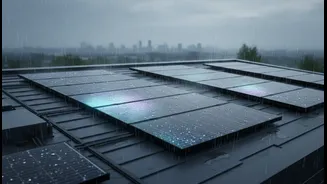









The Problem with Grey Skies
For all its growth, solar energy in India faces a seasonal challenge: the monsoon. For about four months a year, heavy cloud cover can significantly reduce the output of solar farms and rooftop panels. Traditional solar panels, which are overwhelmingly
made from silicon, are at their peak under bright, direct sunlight. When clouds scatter the light, their efficiency drops, creating intermittency in power generation that the national grid must then balance. This variability is a major roadblock to relying more heavily on what is otherwise a clean and abundant energy source. As India pushes towards its ambitious goal of 500 GW of non-fossil fuel capacity by 2030, solving the cloudy-day conundrum has become more critical than ever.
Meet the New Contenders: Perovskites
The most promising solution comes from a class of materials called perovskites. Unlike the rigid, crystalline silicon used in most panels today, perovskites have a unique crystal structure that can be made into a thin, flexible, and lightweight film. What makes them truly exciting is their ability to be 'tuned' to absorb different parts of the light spectrum. Scientists can alter the chemical composition of the perovskite material to make it exceptionally good at capturing the kind of diffuse, high-energy blue and green light that manages to get through cloud cover. While traditional panels are good at capturing a broad range, perovskites can be specifically optimized for the conditions of an overcast day.
The Power of a 'Tandem' Partnership
The real breakthrough, however, may not be replacing silicon but partnering with it. Researchers are having incredible success with 'perovskite-on-silicon tandem' solar cells. In this design, a thin, semi-transparent layer of perovskite is placed on top of a traditional silicon cell. The perovskite layer skims off the high-energy light, for which it is optimized, and lets the rest of the light pass through to the silicon layer below, which is more efficient at capturing lower-energy red light. This tag-team approach allows the tandem cell to harvest a much wider spectrum of sunlight than either material could alone. Efficiency records for these tandem cells are being broken constantly, with lab results now exceeding 34%, well beyond the theoretical limits of silicon-only panels.
A Monsoon-Proof Energy Source?
The implications for India are enormous. A solar panel that performs more consistently during cloudy and rainy seasons would fundamentally change the economics and reliability of solar power. It would help stabilize the grid during the monsoon, reduce the need for fossil-fuel backup power, and make solar a more dependable year-round energy source. For homeowners with rooftop solar under schemes like PM Surya Ghar, it would mean more predictable power generation even during overcast spells. While widespread commercial availability is still on the horizon, the promise of this technology offers a direct answer to one of the most significant challenges facing India's clean energy transition.
The Road to the Rooftop
Despite the record-breaking efficiencies in the lab, perovskite technology still faces hurdles before it can be mass-produced and installed on rooftops across the country. The two biggest challenges are long-term stability and manufacturing scale. Early perovskite cells were known to degrade relatively quickly when exposed to moisture and heat—conditions that are abundant in India. Furthermore, techniques for producing small, high-efficiency lab cells need to be translated into cost-effective methods for manufacturing large, durable panels. Researchers are actively working on these problems, developing protective encapsulation layers and refining production processes. While still a few years away from dominating the market, the pace of innovation is rapid, and some companies are already beginning commercial production of tandem cells.