


A Glimpse Into Cosmic Dawn
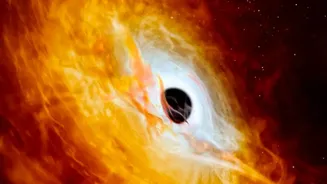
Astronomers recently announced the discovery of the oldest and most distant pair of quasars ever seen, an object nicknamed Nāpōwawāʻenakaulua. These aren't just any cosmic bodies; a quasar is an intensely luminous beacon powered by a supermassive black
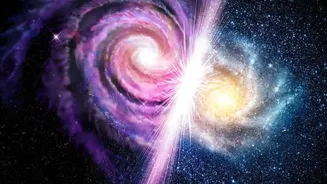
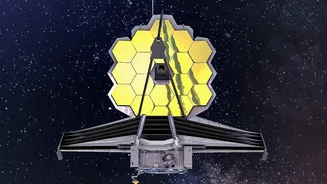
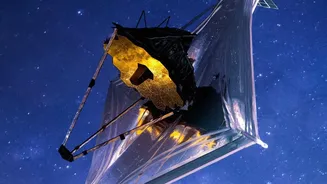
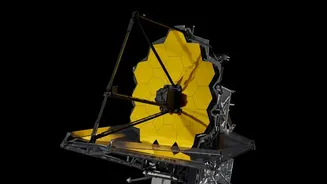
hole actively feeding on surrounding gas and dust. This particular pair is seen as it was just 900 million years after the Big Bang, a period known as the 'cosmic dawn' when the very first stars and galaxies were forming. Discovered using data from the JWST and confirmed with the Gemini North telescope in Hawai'i, the two quasars are located in galaxies that are in the process of merging. They are separated by only 18,100 light-years, which is incredibly close in cosmic terms—about one-fifth the diameter of our own Milky Way galaxy.
The 'Too Big, Too Soon' Problem
Finding one supermassive black hole this early in the universe is already a challenge for existing theories. According to our standard models of cosmology, it should take more than a billion years for a black hole to grow to millions, let alone billions, of times the mass of our sun. Yet, the JWST has been routinely finding these behemoths existing as early as 400 million years after the Big Bang. The discovery of Nāpōwawāʻenakaulua makes the problem even more acute. One black hole in the pair has a mass of 1.5 billion times that of the sun, while its companion weighs in at 400 million solar masses. Finding two of these giants so close together, so early in cosmic history, directly contradicts models that predict a slow, gradual process of black hole growth. There simply shouldn't have been enough time for them to get so big.
Galaxy Mergers as Cosmic Accelerators
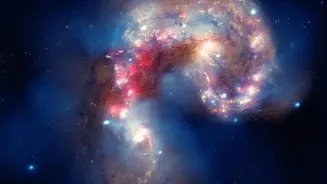
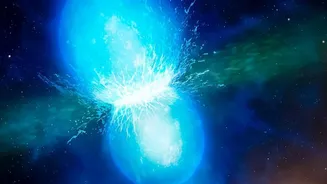
So, how did these cosmic monsters form so quickly? The fact that they are a pair provides a vital clue. Astronomers have long theorized that galaxy mergers were common in the crowded environment of the early universe. When two galaxies collide, the gravitational chaos funnels enormous amounts of gas toward their central black holes, providing a massive feast that dramatically accelerates their growth. Finding this quasar pair in the act of merging provides the strongest evidence yet that these violent interactions were a key driver of black hole growth from the very beginning. The system is likely situated in an exceptionally dense region of the early universe, a node in the 'cosmic web' where filaments of gas and dark matter intersect, providing a rich supply of fuel for both star formation and black hole feeding.
Rewriting the First Chapter of the Universe
Discoveries like this are forcing scientists to completely rethink the first chapter of cosmic history. The JWST is consistently revealing that the early universe was far more developed and complex than previously imagined. Galaxies appear to have formed faster, grown larger, and created heavier elements much sooner than models predicted. The 'too big, too soon' problem isn't just about black holes; it applies to the massive host galaxies themselves. Some theories suggest that the efficiency of star formation might have been much higher in the primordial universe, or that the first 'seed' black holes were born much larger than expected, perhaps from the direct collapse of massive gas clouds rather than from the remnants of a single star. This quasar pair serves as a perfect laboratory to test these new ideas about how the universe's most massive structures assembled.