




A new asteroid, designated 2026 ED138, has been spotted by astronomers, but this isn't just another rock in space. Its discovery is one of the first major wins for the Vera C. Rubin Observatory, heralding a new age of planetary defense.
Meet 2026 ED138
In the vastness
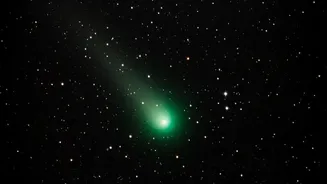
of space, a new object has been given a name. 2026 ED138 is a near-Earth asteroid recently identified by astronomers. While its exact size and composition are still under investigation, initial observations suggest it belongs to the Apollo class of asteroids. This means its orbit crosses Earth's path, making it an object of scientific interest. Provisional names like 2026 ED138 are standard practice, encoding the year of discovery and a letter combination indicating the specific period and sequence of its first sighting. For now, scientists have confirmed that 2026 ED138 poses no threat to our planet. However, its detection is a significant proof of concept for the technologies now scanning our cosmic neighborhood with unprecedented vigilance. The real story isn't just about this one asteroid, but about how we found it.
The Eye in the Sky: Rubin Observatory
The discovery was made possible by the Vera C. Rubin Observatory in Chile, a groundbreaking facility that began its decade-long Legacy Survey of Space and Time (LSST) in mid-2026. Equipped with the world's largest digital camera—a 3,200-megapixel giant—the observatory is an astronomical data-generating machine. Its primary mission is to scan the entire southern sky every few nights, creating what is essentially a motion picture of the universe. This allows astronomers to spot anything that moves or changes against the backdrop of distant stars. The observatory is designed to tackle four major scientific goals: probing dark matter and dark energy, mapping the Milky Way, exploring the transient sky, and, crucially, taking a comprehensive inventory of our solar system.
Finding a Cosmic Needle
So how did 2026 ED138 stand out? The process is a marvel of modern data science. The Rubin Observatory generates about 10 terabytes of data every single night. Human eyes could never sift through it all. Instead, sophisticated software pipelines scan the successive images, looking for faint points of light that have moved. Any moving object is flagged for further analysis. Follow-up observations confirm if the object is new and help calculate its trajectory. This automated, software-driven approach is essential for finding smaller and more distant objects than ever before. Before the LSST even officially began, preliminary surveys using Rubin's hardware had already identified thousands of new asteroids, showcasing the immense power of the system. Discoveries like 2026 ED138 are now expected to become a regular occurrence, turning a trickle of asteroid finds into a firehose of data.
A New Era for Planetary Defense
While 2026 ED138 is harmless, its discovery underscores a paradigm shift in planetary defense. For years, the global scientific community has worked to identify and track near-Earth objects (NEOs) that could pose a potential impact hazard. Historically, many threatening objects have been discovered with little warning time, or missed entirely. The Rubin Observatory changes the game. By surveying the sky so widely, deeply, and rapidly, it is expected to find millions of new asteroids over its tenndear mission, drastically increasing the known catalogue. This is the core purpose of planetary defense programs managed by organizations like NASA's Planetary Defense Coordination Office (PDCO): to find potentially hazardous asteroids far in advance. The more warning time we have, the more options we have to potentially mitigate a threat, a capability demonstrated by missions like DART.