






Cosmic Lighthouses in the Dark
To understand this cosmic map, we first need to understand pulsars. A pulsar is a type of neutron star, which is the incredibly dense, city-sized remnant of a massive star that has collapsed after a supernova explosion. A single sugar-cube-sized piece
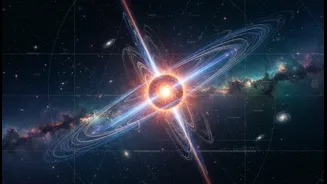
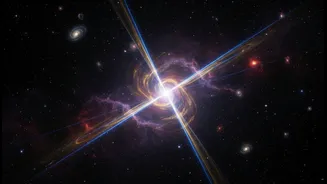
of a neutron star would weigh about a billion tonnes on Earth. Many of these neutron stars spin incredibly fast, some hundreds of times per second. They also have immensely powerful magnetic fields that channel jets of particles and radiation from their magnetic poles. If the star's spin axis is not aligned with its magnetic axis, these beams of energy sweep through space like a lighthouse beam. From our perspective on Earth, when this beam sweeps past our line of sight, we detect a regular pulse of radiation, which is why we call them pulsars.
Seeing the Universe in X-rays
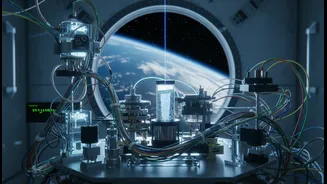
We can't observe these cosmic lighthouses with a standard optical telescope. The energetic processes on and around neutron stars cause them to glow brightly in X-rays. However, Earth's atmosphere absorbs X-ray radiation, making it impossible to study these objects from the ground. This is where X-ray astronomy comes in, using space-based telescopes to detect this high-energy light. For this project, the key instrument is NASA’s Neutron star Interior Composition Explorer, or NICER. Attached to the International Space Station, NICER is an X-ray telescope specifically designed to study neutron stars with incredible precision. It can measure the arrival time of each X-ray it detects with an accuracy better than 100 nanoseconds, giving scientists a revolutionary tool to probe these enigmatic objects.
Mapping an Extreme Surface
The phrase "Lighthouse Pulsar Map" refers to the work NICER does to chart the surfaces of these distant stars. The powerful magnetic fields of a pulsar can create hotspots on its surface that are millions of degrees Celsius and glow brightly in X-rays. As the pulsar spins, these hotspots rotate in and out of view, causing the regular X-ray pulses that NICER detects. By carefully timing and analysing these pulses, scientists can essentially reverse-engineer the process. They can determine the size and location of these hotspots, creating the first-ever surface maps of a pulsar. Early results from NICER have already challenged textbook models. For a pulsar named J0030, scientists expected to find two hotspots at opposite magnetic poles but instead found a more complex arrangement, all located in its southern hemisphere.
A Laboratory for Extreme Physics
This is where the idea of "extreme-space modelling" comes into play. These surface maps are not just an astronomical curiosity; they are a vital clue to what is happening deep inside the neutron star. The immense pressure inside a neutron star crushes matter into a state that cannot be replicated in any laboratory on Earth. Physicists have many theories about this "equation of state," but they need real-world data to test them. The size, mass, and surface features of a pulsar are all directly linked to the properties of the exotic matter in its core. By precisely measuring a pulsar's dimensions, scientists can rule out some theories and refine others. For example, NICER’s observations helped determine that the matter inside neutron stars is less 'squeezable' than some models predicted. Essentially, NICER is using pulsars as giant cosmic laboratories to study the fundamental laws of physics under the most extreme conditions imaginable.