






Why Labels Suddenly Matter More
It feels like everyone is suddenly a nutrition expert, but the truth is simpler: we're more aware of what we eat. With the rise of processed foods, there's a growing conversation about items high in fat, sugar, and salt (HFSS). In response, the Food Safety
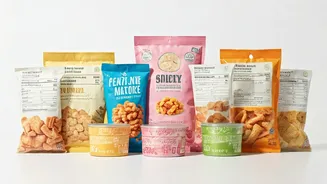
and Standards Authority of India (FSSAI) is pushing for more transparency. The goal is to empower you to know exactly what's inside your packet of chips or box of cereal. This push includes proposals for Front-of-Pack Labelling (FoPL), which would place simple warnings or ratings on the front of packages to help you make quick, healthy decisions without needing a science degree. The discussion has even reached the Supreme Court, highlighting its importance for national health.
First Stop: The Ingredient List
This is the most honest part of the package. Ingredients are always listed in descending order by weight. It's a simple rule: if sugar, maida (refined flour), or an unhealthy oil is one of the first three ingredients, you know what the product is mostly made of. Manufacturers also use dozens of names for sugar to disguise how much is really in there. Look out for words ending in "-ose" (like sucrose, fructose, dextrose) and various syrups (like corn syrup or rice syrup). If you see several of these scattered throughout the list, it's a red flag for a high sugar content, even if the front of the box screams 'healthy'.
Mastering the Nutrition Facts Panel
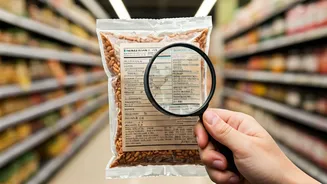
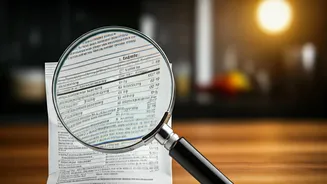
This box of numbers can seem intimidating, but focus on a few key areas. First, check the serving size. All the values listed—calories, fat, protein—are for that single serving, not necessarily the whole packet. Next, look at the % RDA (Recommended Dietary Allowance) or % DV (Daily Value). This tells you how much a nutrient in one serving contributes to your total daily diet, which is based on a standard 2,000-calorie diet. A simple trick is that 5% DV or less of a nutrient is low, while 20% DV or more is high. This is useful for limiting things like saturated fat, trans fat, and sodium, and getting enough of others, like dietary fibre.
The Rise of Front-of-Pack Warnings
The next big change you might see on Indian packaging is a Front-of-Pack Label (FoPL). The idea has been debated for years, with FSSAI considering different models, from 'Health Star Ratings' to simple warning symbols. The goal of a warning label is to give you an at-a-glance understanding if a product is high in sugar, salt, or fat, similar to systems used in countries like Chile and Mexico which have successfully reduced junk food consumption. While the final format for India is still under discussion, the move signals a major shift toward making nutritional information impossible to ignore.
Decoding 'Natural' and 'Organic'
Marketers love using words that create a "health halo" around a product. Terms like "natural," "farm-fresh," or "chemical-free" often have no legal definition and can be misleading. According to FSSAI, a "natural" food must be a single-ingredient product that has not been significantly altered from its original state. "Organic" is much more strictly regulated. For a product to be legally sold as organic in India, it must carry the green 'Jaivik Bharat' logo and be certified under either the National Programme for Organic Production (NPOP) or the Participatory Guarantee System (PGS-India). Without these logos, the claim is just marketing.