



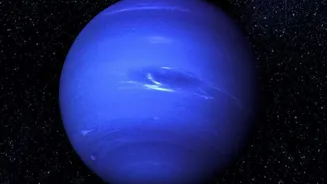
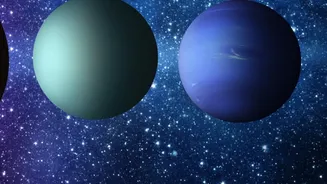
Welcome to the 'Warm Neptune'
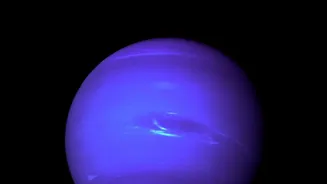
Our solar system provides a familiar planetary lineup, but the galaxy is filled with worlds that defy our local examples. Among the most intriguing are 'warm Neptunes'. These are planets similar in size to our own Neptune or Uranus but orbiting much closer
to their stars. They are not as scorching as 'hot Jupiters' but are far toastier than the ice giants in our backyard. One such world, WASP-107b, has become a recent focus. These planets are important because they represent a common type of planet in the galaxy, yet we have no direct comparison in our own solar system. Studying them fills a critical gap in our understanding of how planets form and evolve across a wide range of environments. Their intermediate size and temperature make their atmospheres a complex and vital laboratory for planetary scientists.
The Double-Edged Sword of Methane
On Earth, methane is strongly associated with life, produced by everything from microbes in wetlands to the digestive systems of cattle. Because of this, it has long been considered a key 'biosignature'—a potential sign of biological processes. However, methane can also be produced by purely geological activity, such as volcanic eruptions, making it a tricky signal to interpret. The mere presence of methane doesn't automatically mean life. What makes it compelling is its instability; methane is broken down by starlight relatively quickly, so its continued presence in an atmosphere implies a large, constant source is replenishing it. Finding methane, especially in combination with other gases like carbon dioxide and an absence of others like carbon monoxide, could point to a chemical disequilibrium that is a strong indicator of life.
A Crucial Scientific Benchmark
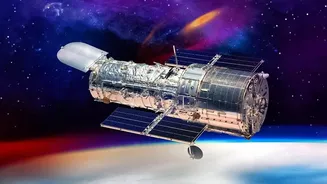
This is where the 'benchmark' aspect comes into play. Detecting methane on a planet like WASP-80 b or in the atmosphere of K2-18b is a massive technical achievement for the James Webb Space Telescope (JWST). These observations prove that our most advanced instruments are sensitive enough to find these subtle chemical fingerprints in the atmospheres of distant worlds. It’s a proof-of-concept that the hardware and the analytical methods work as intended. Every time JWST successfully identifies a molecule that was previously elusive, it calibrates the tool itself. This success builds confidence and provides a reliable standard against which future observations can be measured. It’s like a musician tuning their instrument before a concert; these findings ensure the telescope is perfectly tuned for its ultimate performance: searching for life on smaller, Earth-like planets.
Refining the Interstellar Target List
The time on next-generation telescopes like the JWST is an incredibly scarce and valuable resource. Astronomers from around the world compete for just hours of observation time. This makes target selection a high-stakes strategic decision. The discovery of methane on warm Neptunes helps astronomers refine their strategy. It confirms that planets with certain characteristics are viable candidates for having detectable atmospheres with interesting chemistry. This allows scientists to build better models to predict which other planets are most likely to yield significant discoveries. Instead of pointing their multi-billion-dollar telescope at random, they can now prioritize targets that are more likely to have the specific conditions—and chemical signatures—they are looking for. This finding helps narrow the search, focusing precious resources where they have the highest chance of success.
Powering Future Space Exploration
The JWST is just the beginning. The lessons learned from its observations of warm Neptunes are already shaping the objectives for future missions. The Nancy Grace Roman Space Telescope, NASA's next flagship mission, will survey huge swaths of the sky to find new exoplanets. Ground-based observatories like the Extremely Large Telescope will use advanced optics to peer at these worlds with even greater detail. The success with methane on warm Neptunes provides a clear scientific case for building these even more powerful observatories. It demonstrates that we have the capability to probe alien atmospheres, and with more advanced technology, we can move from detecting methane on gas giants to searching for biosignatures on small, rocky worlds that might resemble our own. Each detection is a step on a technological ladder, leading us toward answering one of humanity’s oldest questions.