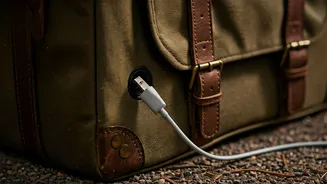









The Illusion of the 'Smart' Backpack
Walk through any electronics store or browse online marketplaces, and you’ll be flooded with advertisements for the 'smart' backpack. These bags are marketed as the ultimate solution for the modern commuter, student, or traveller. They boast built-in
USB-A or USB-C ports to charge your phone on the go, dedicated pockets for power banks, and sometimes even Bluetooth trackers or TSA-approved locks. On the surface, it’s a compelling proposition. Who wouldn’t want a backpack that seamlessly integrates with their digital life? The promise is one of convenience—a single, elegant solution to the perennial problem of a dying phone battery and tangled cables. But this promise is built on a foundation of features that are, at best, redundant and, at worst, destined to fail.
When 'Features' Become Failures
The problem with over-engineered bags is that every added feature is a potential point of failure. That 'convenient' built-in USB cable is often a low-quality wire that will fray or stop working after a few months of being jostled around. The port itself is a weak point, susceptible to dust, moisture, and physical damage. When it rains, you’re not just worried about your laptop; you’re worried about a short-circuiting port. Furthermore, the technology inside these bags is fixed. You’re stuck with a USB-A port when the world has moved to USB-C. You can’t upgrade the charging speed. The bag’s tech becomes obsolete far faster than the bag itself wears out. And for what? The core function—charging your device—is accomplished by a separate power bank you still have to buy and carry. The 'smart' bag merely adds a cheap, vulnerable cable between your power bank and the outside world.
Enter the Humble Mountain Backpack
Now, consider the alternative: a basic, lightweight daypack designed for hiking or mountaineering. These bags are engineered with a completely different philosophy. Instead of adding features, they strip everything away that isn't essential for comfort, durability, and function in harsh environments. Their 'features' are not electronic; they are physical and time-tested. They are built from rugged, water-resistant materials like Cordura or Ripstop nylon, designed to be scraped against rocks, not just placed on a cafe floor. The zippers are robust and often water-sealed. The buckles are simple, strong, and easily replaceable if they ever break. Most importantly, the harness systems—the shoulder straps, sternum strap, and hip belt—are ergonomically designed to distribute weight comfortably for hours on end. These bags are made to carry loads, not just hold gadgets.
A Philosophy of Simplicity and Reliability
Choosing a simple mountain backpack over a 'smart' one is more than just a practical decision; it’s adopting a philosophy of self-reliance and durability. You are not dependent on a fragile, integrated system. You carry a high-quality, separate power bank that you can upgrade anytime. You keep it inside the bag, protected from the elements, and run a cable out only when needed. This modular approach is more resilient and adaptable. If a cable fails, you replace a ₹500 cable, not your entire ₹5,000 backpack. If you need more power, you buy a better power bank. The backpack remains a simple, reliable shell—a tool that does one job exceptionally well: carrying your things comfortably and securely. It frees you from the anxiety of another gadget failing and allows you to trust the gear on your back, whether you’re navigating a crowded metro or a rainy hiking trail.