





The Sun’s Mysterious Middle
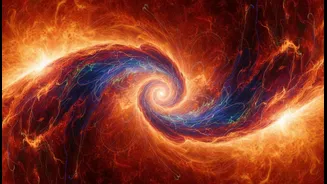
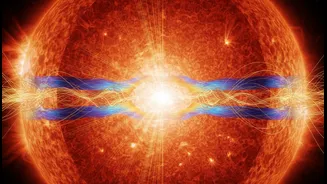
Deep beneath the Sun's turbulent surface lies a region that has baffled scientists for decades: the tachocline. Imagine it as a boundary layer, separating two distinct parts of the Sun's interior. Above it is the convection zone, a chaotic, boiling sea
of hot plasma that covers the outer 30% of the Sun. Below it is the radiative zone, a calmer region where energy slowly radiates outward from the core. The inner radiative zone rotates like a solid, unified ball, while the outer convection zone spins at different speeds—faster at the equator and slower at the poles. The tachocline is the incredibly thin transition between these two clashing rotational speeds. Data from helioseismology, the study of the Sun's interior using wave oscillations, suggests this layer is located about two-thirds of the way out from the Sun's center but is only about 4% of the Sun’s radius in thickness.
A Puzzle of Sheer Force
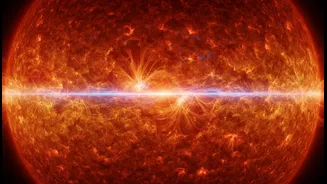
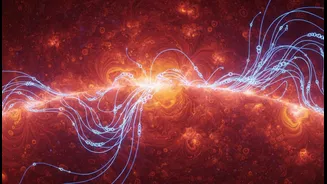
The primary mystery of the tachocline is why it is so thin and stable. Basic physics suggests that the friction between the fast-spinning inner part and the slower, churning outer part should cause this boundary layer to be much thicker and more diffuse. The sheer force is immense, yet the tachocline remains sharply defined. For years, scientific models have failed to replicate this reality. This is a significant problem because the tachocline is not just a passive boundary; it is believed to be the engine room for the Sun's magnetic activity. Scientists theorise that the intense shearing action in this layer amplifies and organizes the Sun's magnetic field, essentially 'storing' magnetic energy before it rises to the surface to form sunspots. These sunspots are the origin points for solar flares and coronal mass ejections, the major components of space weather.
Enter NASA's COFFIES Initiative
To crack this solar puzzle, NASA has assembled a team of experts under a project called COFFIES (Consequences Of Fields and Flows in the Interior and Exterior of the Sun). This DRIVE (Diversify, Realize, Integrate, Venture, Educate) Science Center brings together researchers to build the most comprehensive and data-driven models of the Sun possible. The goal is to understand the complex interplay of plasma flows and magnetic fields that govern the Sun's 11-year activity cycle. A key focus of the COFFIES project is to solve the mystery of the tachocline and another strange area called the Near-Surface Shear Layer. By combining observations from missions like the Solar Dynamics Observatory with cutting-edge supercomputer simulations, the team aims to build a virtual Sun that behaves like the real thing.
A Breakthrough in the Simulations
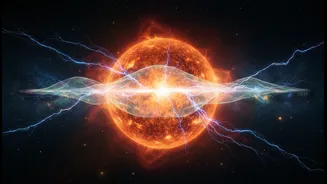
Recent work by the COFFIES team has resulted in a major breakthrough. By refining their state-of-the-art computer models, the researchers have created the first self-consistent simulation that reproduces the tachocline's signature thinness without artificially forcing it. The new simulations suggest a dynamic relationship is at play. They show that while the tachocline's shear is essential for driving the solar dynamo (the process that creates the magnetic field), it is a fluctuating magnetic field within the layer that is key to keeping it so thin. In essence, the magnetic forces appear to provide a kind of containment, preventing the shear layer from expanding. These findings, published in The Astrophysical Journal, finally offer a plausible physical explanation for a phenomenon that has long eluded scientists.
Why This Solar Secret Matters
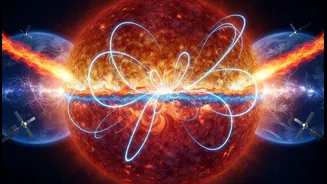
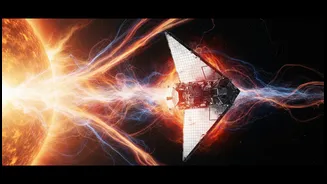
Understanding the tachocline is more than just an academic exercise. Because this layer is the birthplace of the Sun's main magnetic field, deciphering its mechanics is fundamental to predicting space weather. Solar flares and coronal mass ejections can send torrents of charged particles toward Earth, posing a threat to astronauts, damaging crucial satellites used for communication and navigation, and even disrupting power grids on the ground. By creating more accurate models of the Sun's interior engine, scientists can improve their forecasts of solar activity, giving us a better chance to prepare for and mitigate the impacts of severe space weather events. This research is a crucial step toward understanding not just our own star, but also the thousands of other stars in our galaxy, many of which have even more violent space weather.