




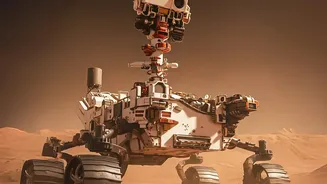
The Red Planet's Dusty Downfall
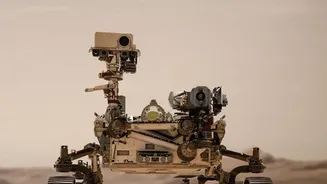
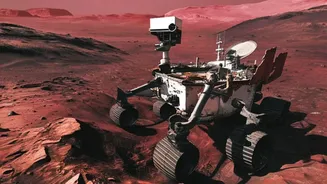
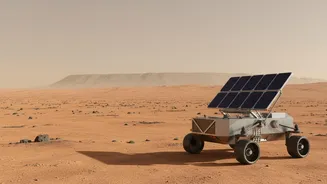
The story of NASA's Opportunity rover is both a triumph and a cautionary tale. Designed for a 90-day mission, it explored Mars for nearly 15 years, powered by its solar panels. But in 2018, a planet-encircling dust storm blotted out the sun. The fine,
electrostatically charged Martian dust coated its panels, blocking sunlight and preventing the rover from recharging its batteries. Despite months of attempts to re-establish contact, Opportunity's mission was declared over, a victim of low power and the extreme Martian cold. This event highlighted a critical vulnerability for any long-term mission on Mars: dust is a mission killer. Unlike the nuclear-powered Curiosity rover, which is largely immune to darkened skies, any hardware relying on sunlight is at the mercy of Martian weather.
An Eye in the Martian Sky
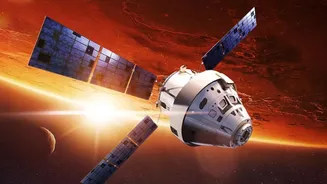
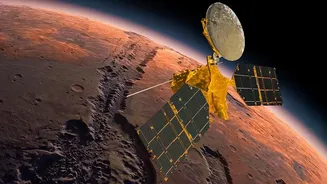
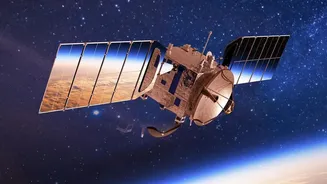
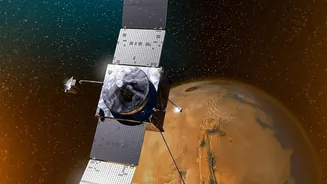
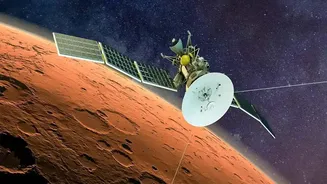
This is where the orbiters come in. A fleet of spacecraft circle Mars, acting as our planetary weather satellites. Missions like NASA's Mars Reconnaissance Orbiter (MRO), Mars Odyssey, and MAVEN (Mars Atmosphere and Volatile EvolutioN) are constantly monitoring the atmosphere. Instruments like MRO's Mars Color Imager (MARCI) create daily global maps, allowing scientists to spot storms as they form and track their evolution. At the same time, instruments like the Mars Climate Sounder (MCS) and Odyssey's THEMIS measure atmospheric and surface temperatures. These temperature readings are vital because dust storms are powered by solar heating. As dust lifts, it warms the surrounding atmosphere, which in turn generates more wind, lifting more dust in a runaway effect that can lead to global storms. These orbiters are our first line of defense, providing an early warning system for assets on the ground.
From Data to Dust Forecasts
Collecting data is only half the battle; the real challenge is turning it into a reliable forecast. Scientists combine the continuous stream of orbiter data—tracking dust location, atmospheric temperature, and pressure changes—with complex computer simulations called Global Climate Models (GCMs). By feeding real-world observations into these models, researchers can test and refine their understanding of Martian weather dynamics. This process, known as data assimilation, helps build a more accurate picture of how and why storms start and grow. Researchers have already identified key patterns, such as storms frequently originating near the polar ice caps and moving toward the equator, often after periods of increased surface temperature. While accurately predicting the exact timing and location of a specific storm remains a major challenge, these models are becoming increasingly crucial for forecasting seasonal risks and understanding the 'rules' of Martian weather.
Engineering a Cleaner Future
This orbital weather-watching directly informs how we design the next generation of Martian hardware. Knowing the size, frequency, and composition of dust helps engineers build more resilient systems. For future human habitats and robotic explorers that will rely on vast solar farms, this information is not just useful—it's essential. Data on dust accumulation rates helps determine how robust solar panels need to be. It also drives the development of dust mitigation technologies. While occasional gusts of wind, known as 'cleaning events,' have unexpectedly extended the lives of rovers in the past by blowing panels clean, this can't be relied upon. Therefore, engineers are developing active cleaning solutions, such as systems that use electrostatic charges to repel dust particles, a technology informed by understanding the very nature of the dust the orbiters help study. Furthermore, long-term weather data helps mission planners select safer landing sites with historically lower storm activity.
Powering the First Martian Base
Ultimately, the goal of these observations is to safeguard the massive investment and human lives involved in future Mars exploration. A permanent human settlement will require a continuous, reliable power grid, and solar energy is a leading candidate. The lessons learned from Opportunity's demise and the data gathered by orbiters like MRO are foundational to making this possible. By understanding the mechanics of dust storms, we can create smarter mission plans, build tougher equipment, and develop operational protocols for when the skies inevitably darken. These orbiter observations are a form of planetary risk assessment, ensuring that when the first astronauts set up their solar arrays on Mars, they have the knowledge to withstand the planet's most persistent environmental threat.