


Seeing Through the Cosmic Fog
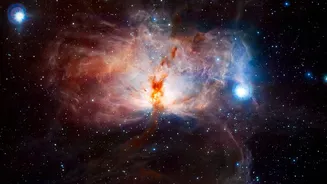
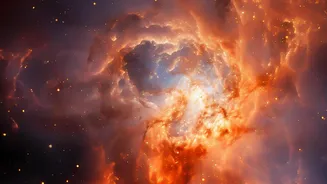
Imagine trying to watch a sculptor work inside a dusty room. This is the challenge astronomers face when observing stellar nurseries, the vast clouds of gas and dust where stars are born. Visible light telescopes are blinded by these opaque clouds. The
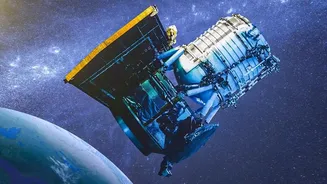
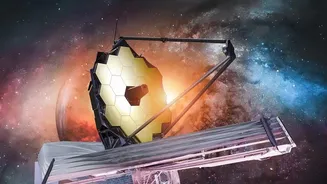
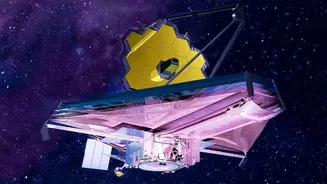
JWST, however, is a game-changer because it sees in infrared light. Infrared wavelengths can pass through the dense dust, allowing scientists to peer directly into the heart of these formation zones. This unique capability is like having a pair of x-ray glasses for the cosmos, revealing the intricate processes of star and planet birth that were previously hidden from view.
Anatomy of a Planetary Cradle
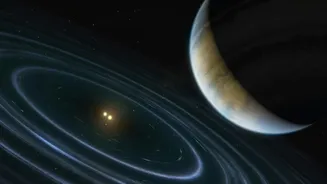
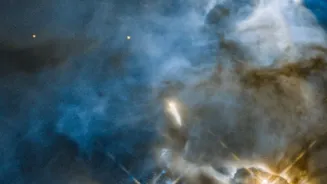
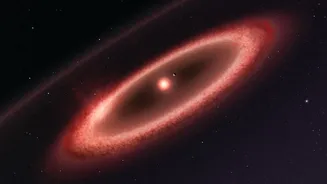
When Webb looks at a young star, it often sees a vast, rotating platter of gas and dust called a protoplanetary disk. This disk is the raw material from which future planets are built. For the first time, Webb's high-resolution instruments can map the structure of these disks in incredible detail. In systems like HH 48, astronomers can now distinguish not only the disk itself but also the powerful jets and wide-angle outflows of material being ejected by the young star. These observations are crucial because the distribution of material and the dynamic activity within the disk determine what kind of planets will eventually form.
Finding Life's Ingredients
One of Webb’s most exciting capabilities is spectroscopy—the ability to analyze light to determine the chemical makeup of distant objects. By studying the light filtering through protoplanetary disks, astronomers are creating an inventory of the molecules available for planet formation. The results are stunningly diverse. Webb has confirmed the presence of water, carbon dioxide, methane, and even complex organic molecules like benzene in these cosmic cradles. This tells us that the fundamental building blocks for life as we know it are present right from the very beginning, seeding these nascent solar systems with the potential for habitable worlds.
Witnessing the Moment of Creation
Planet formation is not a gentle or orderly process; it's a chaotic ballet of gravity and matter. Webb's sharp vision is capturing this drama in action. In a young star system named HOPS-315, scientists using both Webb and the ALMA telescope have observed what they believe is the very first stage of planet formation: hot, gaseous silicon monoxide beginning to condense into solid silicate minerals. These are the first specks of dust that will eventually clump together to form rocky planets like Earth. In other disks, Webb has revealed distinct gaps and spiral arms, which are tell-tale signs of newly formed planets carving out their orbits and gravitationally sculpting their environment.
Challenging What We Thought We Knew
The data from Webb isn't just confirming old theories; it's rewriting them. For example, observations have shown that the chemical composition of protoplanetary disks varies significantly from one star system to another, a diversity that scientists are still working to understand. Webb has also found that in some environments, particularly those in the early universe with fewer heavy elements, these planet-forming disks can survive for 20 to 30 million years—much longer than previously thought. This extended timeline could mean that planets, and perhaps life-friendly environments, had more time to develop than our models predicted, making them potentially more common across the cosmos.