



Meet ChaSTE: The Moon's Thermometer
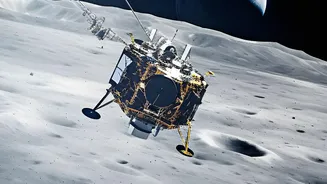
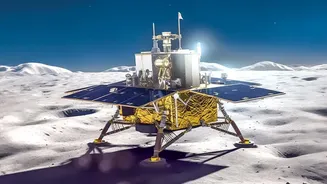
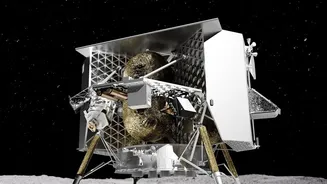
At the heart of this discovery is a remarkable instrument aboard the Vikram lander called the Chandra’s Surface Thermophysical Experiment, or ChaSTE. Developed by a team from ISRO's Space Physics Laboratory and the Physical Research Laboratory, ChaSTE is essentially
a high-tech thermometer designed for the Moon. It consists of a slender probe that can slowly and carefully penetrate up to 10 centimetres into the lunar soil, a powdery layer of crushed rock and dust known as regolith. Fitted with 10 individual temperature sensors along its length, the probe’s primary job is to measure how heat moves through the topsoil, creating the first-ever in-situ thermal profile of the lunar south pole region.
A Surprising Three-Layer Structure
What ChaSTE found was unexpected. Instead of a uniform material, the data, detailed in a study published in 'npj Space Exploration', revealed three distinct layers within that shallow 10-centimetre depth, each with different properties. The very top layer, extending down about 3 cm, is incredibly porous and fluffy, with a low density. Below that, from 3 to 6 cm, lies a middle layer that is more compact and conducts heat better. The third layer, from 6 to 10 cm, is denser still. Scientists noted that the density nearly triples from the surface to a depth of 10 cm, and its cohesiveness also increases significantly, a finding that challenges previous estimates from earlier lunar missions.
An Exceptional Insulator
This layered structure creates a powerful insulating effect. During the lunar day, ChaSTE recorded a dramatic temperature difference of about 73 Kelvin (a 73-degree Celsius drop) between the sun-baked surface and a point just 10 cm below it. The surface can be as hot as 40-50 degrees Celsius, while just a few centimetres deeper, the temperature plunges to around -10 degrees Celsius. This demonstrates that the loose, porous topsoil is remarkably effective at trapping heat and preventing it from penetrating deeper into the Moon. This quality is crucial, as the thermophysical properties of the soil dictate everything from how rovers move to how future lunar habitats might be constructed.
Why This Finding Matters for Future Missions
This detailed understanding of the lunar topsoil is not just an academic exercise; it has profound implications for the future of space exploration. The data provides a vital 'ground truth' for scientists, against which they can compare readings from orbiters and better assess other potential landing sites. For engineers planning to build lunar habitats, knowing that the regolith is a superb natural insulator is a game-changer. Placing structures even a few centimetres below the surface could dramatically reduce the need for complex and heavy heating and cooling systems, protecting equipment and astronauts from the extreme temperature swings.
Clues for Water Ice and Construction
Furthermore, the soil's structure could influence how water ice, believed to be trapped in the shadowed craters of the south pole, is retained or lost. The properties of these layers will affect how water migrates and whether it can be preserved just below the surface. For any construction or resource extraction, understanding the soil's density and cohesion is fundamental. Early analysis from Vikram's 'hop' manoeuvre, where its engines blew away the top layer, showed the subsurface was much denser—likened to the difference between walking on flour versus stiff clay. Knowing this layered 'cake-like' structure is critical for designing drills, excavators, and foundations for a sustained human presence on the Moon.