

The Challenge of Seeing Air
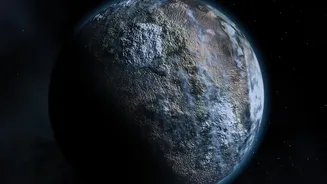
Studying rocky, Earth-sized exoplanets is incredibly difficult. Unlike giant gas planets, their atmospheres are thin and their gravitational pull is weaker. They are also incredibly faint, lost in the glare of their parent stars. For decades, astronomers
could only confirm their existence and measure basic properties like size and mass. Determining if they had an atmosphere, let alone what it was made of, remained largely out of reach. This is because these planets don't produce their own light, making direct observation nearly impossible. The challenge is not just seeing the planet, but analyzing the tiny, fleeting signals that might betray the presence of an atmosphere.
Webb's Infrared Superpower
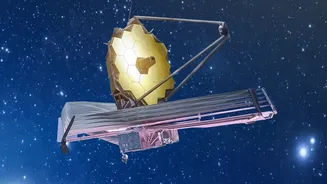
This is where the James Webb Space Telescope changes the game. Its power lies in its huge mirror and its focus on infrared light. JWST uses a technique called transit spectroscopy. As an exoplanet passes in front of its star, a tiny fraction of starlight filters through the planet’s atmosphere, if one exists. Different gases—like carbon dioxide, methane, or water vapor—absorb specific wavelengths of this light. JWST's highly sensitive infrared instruments, like the Near-Infrared Spectrograph (NIRSpec) and Mid-Infrared Instrument (MIRI), can detect these absorption patterns. Think of it like a chemical barcode imprinted on the starlight. By reading this barcode, scientists can identify the molecules present in that alien sky.
First Glimpses of Alien Skies
JWST has already turned its infrared eyes on several fascinating rocky worlds, delivering a mix of surprising and puzzling results. For the seven planets in the TRAPPIST-1 system, 40 light-years away, the findings have been a reality check. The innermost planets, TRAPPIST-1b and 1c, appear to be bare rock with no significant atmosphere, likely stripped away by their star's harsh radiation. For others, like TRAPPIST-1d, Webb has ruled out a thick, hydrogen-dominated atmosphere, though a thinner one remains a possibility. These early results show that even in a promising system, a planet having an atmosphere is far from guaranteed. Recent observations of LHS 1140 b, however, have provided the first exciting confirmation of an atmosphere on a rocky planet in its star's habitable zone, proving it is possible for these worlds to hold onto their air.
Decoding Lava Worlds and Surfaces
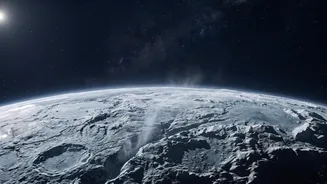
Webb isn't just looking for air; it's also mapping the surfaces of some of the most extreme planets known. Take 55 Cancri e, a searingly hot "super-Earth" so close to its star that its surface is likely a molten ocean of magma. It was long debated whether such a planet could even retain an atmosphere. Recent JWST data suggests it has a substantial atmosphere, likely rich in carbon monoxide or carbon dioxide, which may be constantly replenished by gases bubbling out of its magma ocean. The telescope can also measure the temperature difference between the permanent day and night sides of these tidally-locked planets. A large temperature difference suggests little to no atmosphere to circulate heat, as seen on TRAPPIST-1b. This thermal mapping provides another powerful clue to understanding the nature of these distant worlds.
The Search for Habitability
While JWST has not definitively detected a truly Earth-like atmosphere on a rocky exoplanet yet, every observation adds a crucial piece to the puzzle. The detection of molecules like water, methane, and carbon dioxide are key steps in identifying potentially habitable worlds. For example, recent studies of candidate 'Hycean' worlds—planets with water oceans under hydrogen-rich atmospheres—have detected both methane and carbon dioxide, providing key ingredients for potential life. Even the absence of an atmosphere provides critical data, helping scientists refine models of planet formation and understand what makes a planet lose its air. The telescope is not looking for life itself, but for the conditions that could support it. Each spectrum and temperature map brings us closer to understanding whether the ingredients for life are common in the galaxy and, ultimately, if we are alone.