



The Sun's Turbulent Outbursts
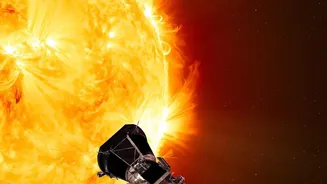
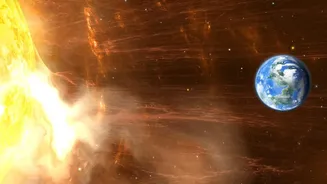
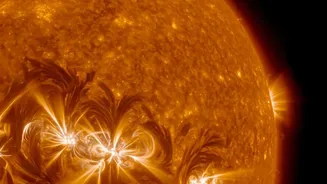
Our Sun is not the serene, unchanging ball of fire it might appear to be. It has a dynamic and often violent atmosphere. Occasionally, it releases enormous bursts of energy and particles in the form of solar flares and coronal mass ejections (CMEs). A
solar flare is an intense explosion of radiation, while a CME is a massive bubble of plasma and magnetic field that hurtles into space. When Earth is in the path of these events, we experience space weather. These solar storms can interact with our planet’s magnetic field and upper atmosphere, creating phenomena like the aurora, but also posing a significant risk to our technology.
Satellites Under Celestial Siege
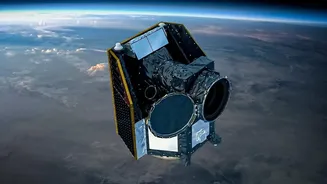
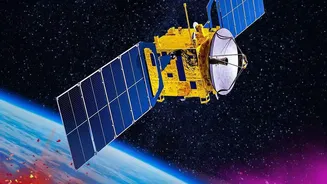
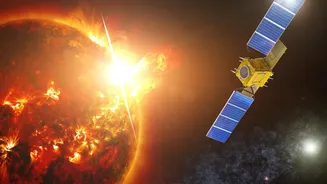
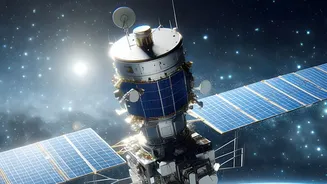
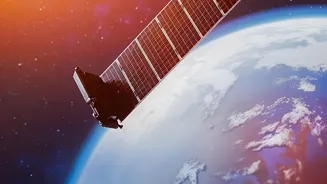
Modern life is built on satellites, which are highly vulnerable to space weather. The high-energy particles from a solar storm can damage sensitive electronics, causing malfunctions or permanent failure. This is known as radiation damage. Another threat is spacecraft charging, where hot plasma accumulates on a satellite's surface, creating voltage differences that can lead to short circuits. These storms also heat and expand Earth's upper atmosphere, increasing atmospheric drag on satellites in low-Earth orbit, which can alter their trajectory and even cause them to de-orbit. Furthermore, the disturbances in the ionosphere can disrupt communication signals to and from satellites, affecting everything from global navigation systems like GPS to satellite television and long-distance radio communication.
Eyes on the Sun: Ground-Based Sentinels
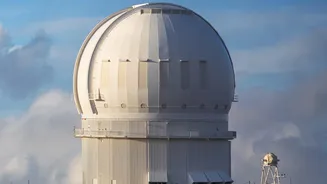
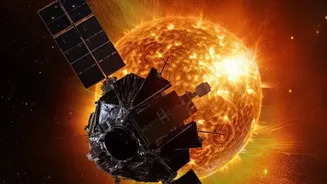
While space-based missions like India's Aditya-L1 provide a crucial first line of defense, a global network of ground-based observatories forms the backbone of our space weather monitoring system. These facilities use a variety of instruments to constantly watch the Sun and Earth's magnetic environment. Solar telescopes track sunspots and active regions, which are often the source of flares and CMEs. Magnetometers measure changes in Earth's magnetic field, providing real-time data on geomagnetic storms. Other instruments, like radio telescopes and ionospheric sounders, monitor the effects of solar radiation on our atmosphere, helping to forecast disruptions to radio communications and GPS.
India’s Crucial Role in Solar Watch
India plays a significant and growing role in this global effort. The Udaipur Solar Observatory (USO), strategically located on an island in Lake Fatehsagar to ensure clearer solar images, is a key facility. Operated by the Physical Research Laboratory, USO focuses on studying solar flares, sunspots, and magnetic fields, contributing vital data for space weather prediction. Another major centre is the Aryabhatta Research Institute of Observational Sciences (ARIES) in Nainital, where scientists develop advanced algorithms to track CMEs and study the physics behind solar eruptions. These observatories, along with others like the Kodaikanal Solar Observatory, are part of India's multi-institutional network for monitoring space weather impacts, known as INSWIM, working in concert with space missions to provide a comprehensive picture of solar activity.