

The Junkyard Above Our Heads
Low-Earth orbit (LEO), an orbital band up to 2,000 kilometres from the planet’s surface, is a critical resource. It’s home to thousands of active satellites that power everything from GPS and internet services to climate monitoring and national security.
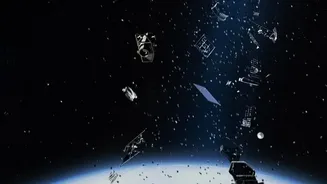
But it’s also a scrapyard. Alongside these operational satellites are thousands of defunct ones, spent rocket stages, and an estimated 1.2 million pieces of untrackable debris larger than one centimetre. Each piece travels at speeds of over 28,000 km/h. At that velocity, even a small object can strike an active satellite with catastrophic force, creating thousands more pieces of debris. This scenario, known as the Kessler Syndrome, describes a runaway cascade of collisions that could render entire orbits unusable for generations. The collision risk in LEO has been rising sharply, with some reports indicating a 20% jump since 2024 alone, driven by the rapid growth of satellite megaconstellations.
The Rise of Active Debris Removal
For years, the primary strategy for dealing with space junk was mitigation—designing new satellites to de-orbit themselves at the end of their lives. However, this doesn't address the millions of fragments and older, non-compliant objects already there. This has given rise to a new and urgent field: Active Debris Removal (ADR). ADR involves sending a 'chaser' spacecraft to rendezvous with, capture, and safely dispose of a piece of debris, usually by dragging it into the atmosphere to burn up. This is no simple task. The targets are often tumbling unpredictably and were never designed to be captured. Despite the challenges, a new commercial industry is emerging, with private companies and space agencies alike developing the technology to become the solar system’s first garbage collectors.
Firing the Harpoon
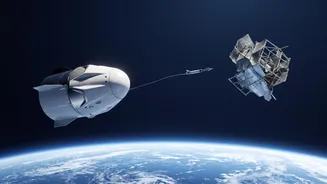
One of the most direct methods for capturing an uncooperative target is a harpoon. The concept is straightforward: a chaser spacecraft fires a piercing projectile tethered to itself into the target debris. Once embedded, the tether allows the chaser to control the object, stabilize its tumble, and pull it into a disposal orbit. Companies like Airbus have developed and tested prototypes, demonstrating their ability to puncture the panels typically used in satellite construction. The RemoveDEBRIS mission, a project led by the Surrey Space Centre, successfully test-fired a harpoon at a target plate in orbit back in 2019, proving the concept's viability. The main advantages of a harpoon are its simplicity and speed. The capture happens in less than a second, making it less sensitive to the target's spin.
Casting a Cosmic Net
Another capture technology that has been successfully demonstrated in orbit is the net. Much like its terrestrial counterpart, a space net is designed to be launched from a chaser vehicle to envelop a piece of debris. The RemoveDEBRIS mission also trialled this method, successfully deploying a net to capture a target. Some concepts involve 'magnetic nets', which could use conductive threads to generate an electromagnetic field to help attract and control debris. While effective for capturing a wide variety of object shapes and sizes, nets can be complex. The dynamics of a net wrapping around a tumbling object are difficult to predict, and there is a risk of the capture process itself creating new, smaller fragments.
Robotic Arms and Magnetic Plates
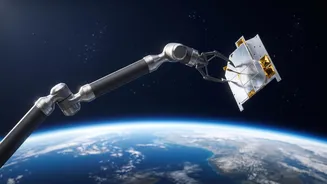
Beyond harpoons and nets, companies are developing even more advanced solutions. The European Space Agency's ClearSpace-1 mission, expected to launch in 2028, will use a craft with four robotic arms to 'hug' and capture a defunct ESA satellite. Meanwhile, Japanese company Astroscale has pioneered a different approach. Their ELSA-d mission successfully demonstrated a magnetic docking system, where a servicer spacecraft repeatedly captured a client satellite equipped with a ferromagnetic plate. This solution is primarily for future satellites, which can be built with this docking plate from the start, making end-of-life removal a standardized service. Astroscale is now moving on to missions like ADRAS-J2, which aims to inspect and eventually remove a large piece of an old Japanese rocket.