



For decades, science has confidently stated the universe is about 13.8 billion years old. But what if it were almost twice that? A new, controversial theory does just that, doubling the age of our cosmos to 26.7 billion years.
The Standard Story of Our Universe
The current and widely accepted
model of cosmology, known as the Lambda-CDM model, tells a specific story about our universe. It began with the Big Bang and has been expanding ever since. By measuring this expansion and observing the oldest light in the cosmos—the cosmic microwave background—scientists have calculated the universe's age to be approximately 13.8 billion years. This age has been confirmed by multiple methods, including studying the life cycles of the oldest stars. For years, this number has been a cornerstone of our understanding of cosmic history, providing a timeline for everything from the formation of the first atoms to the birth of galaxies, stars, and planets.
A Radically Older Proposal
A new model, developed by Rajendra Gupta, a physicist at the University of Ottawa, dramatically revises this timeline. His work proposes the universe is actually 26.7 billion years old. This isn't just a small adjustment; it's a fundamental rethinking of how the cosmos works. The model is called the 'Covarying Coupling Constants + Tired Light' model, or CCC+TL. According to Gupta, this framework can not only account for existing observations but may also solve some of the newest puzzles in astronomy without the need for mysterious substances like dark matter and dark energy.
Solving the 'Impossible Galaxy' Problem
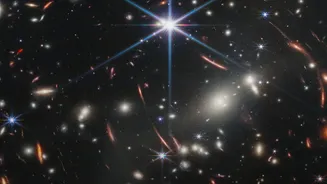
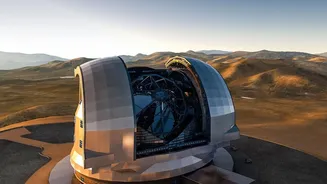
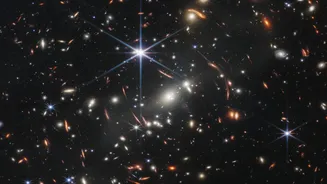
A key motivation for this new model comes from recent observations by the James Webb Space Telescope (JWST). The powerful telescope has spotted galaxies in the early universe that appear shockingly mature and massive. Under the standard 13.8-billion-year model, these galaxies existed when the universe was just a few hundred million years old, which may not have been enough time for them to grow so large. Gupta’s model solves this problem by stretching out the timeline. In a 26.7-billion-year-old universe, these 'early' galaxies would have had billions of years to develop, making their observed maturity entirely plausible.
Resurrecting 'Tired Light'
At the heart of the CCC+TL model is the revival of a nearly century-old and highly controversial idea called 'tired light'. First proposed by Fritz Zwicky in 1929, this theory suggests that light loses energy as it travels over immense cosmic distances. This energy loss would make light appear redder, a phenomenon known as redshift, which is usually attributed entirely to the expansion of the universe. The 'tired light' theory was largely dismissed by scientists because it failed to match key observations, such as the brightness of distant objects. Gupta’s model combines a version of 'tired light' with another concept: that the fundamental constants of nature, which govern forces like gravity and electromagnetism, can change over time.
Why The Scientific Community Is Skeptical
Doubling the age of the universe is an extraordinary claim that faces significant hurdles. The standard Lambda-CDM model is supported by a vast and diverse body of evidence, including the cosmic microwave background, the distribution of galaxies, and the abundance of light elements in the cosmos. Many cosmologists argue that 'tired light' theories have been robustly disproven. Critics point out that for a new model to be accepted, it must not only explain a few anomalies but must also perfectly match all the data the current model already explains. Professor Tamara Davis of the University of Queensland noted that many different types of measurements all point toward the 14-billion-year age. The consensus remains that while provocative, the 26.7-billion-year model has not yet met this high bar and remains on the fringes of cosmological thought.