


Galaxies Growing Up Too Fast
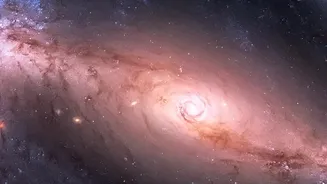
For decades, astronomers worked with a relatively tidy story of galaxy formation: small, simple gas clouds slowly coalesced over billions of years, gradually igniting with stars and merging to form the grand spirals and giant ellipticals we see today.
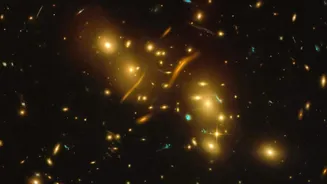
But recent observations, particularly from the James Webb Space Telescope, are showing this story is far too simple. Astronomers are now regularly finding galaxies in the early universe, just a few hundred million years after the Big Bang, that are shockingly bright, massive, and structurally mature. Objects like JADES-GS-z14-0, one of the most distant galaxies ever confirmed, existed when the universe was less than 300 million years old, yet it is surprisingly luminous and chemically complex. This discovery challenges our fundamental timelines for cosmic evolution. Finding such developed galaxies so early suggests the processes that build large structures happened much faster and more efficiently than our models predicted.
Rewriting the Chemical Cookbooks
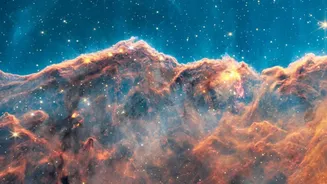
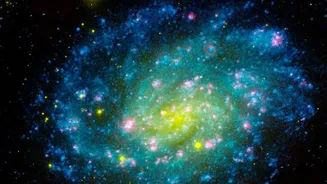
Another major surprise is the chemical composition of these ancient galaxies. The early universe should have been composed almost exclusively of hydrogen and helium, the lightest elements forged in the Big Bang. Heavier elements, which astronomers call 'metals', are created inside stars and blasted out into the cosmos when those stars die. Finding significant amounts of elements like nitrogen and oxygen in galaxies from the universe's infancy is a puzzle. It implies that multiple generations of massive stars must have been born, lived, and died within an incredibly short window of time—much shorter than previously thought possible. To understand this rapid enrichment, some astronomers are now studying nearby 'analogue' galaxies like Sextans A, which have similar chemical conditions to their ancient counterparts, offering a local laboratory to study processes that happened billions of years ago.
The Engines of Creation and Destruction
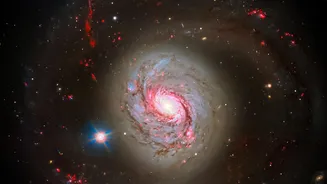
At the heart of nearly every massive galaxy, including our own Milky Way, lies a supermassive black hole. For a long time, the relationship was thought to be simple: the bigger the galaxy, the bigger the black hole. New research reveals a much more dynamic and complex interplay. Recent discoveries from the Euclid Space Telescope have identified dozens of ancient quasars—incredibly bright galactic cores powered by feeding supermassive black holes—shining brightly in the early universe. These cosmic engines don't just consume matter; they also pump enormous amounts of energy back into their host galaxies, a process called 'stellar feedback'. This feedback can blow gas out of a galaxy, shutting down star formation, or it can compress gas clouds, triggering new bursts of star birth. Understanding this delicate and often violent balance is now a key focus for explaining why some galaxies thrive while others fade away.
A More Complex Cosmic Web
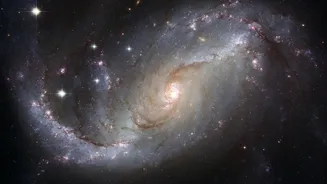
Galaxies are not isolated islands. They are part of a vast, interconnected structure called the cosmic web, made of long filaments of gas and dark matter. New observations show this web is not just scaffolding, but an active participant in galaxy evolution. Astronomers are now seeing the earliest evidence of galaxies being built from the inside out, with stellar bars—like cosmic conveyor belts—funneling gas from the web toward the galactic center to fuel star formation. Meanwhile, other studies are challenging long-held beliefs about how galaxies 'die'. New simulations suggest that dramatic mergers are not the main reason galaxies stop forming stars. Instead, it may be a slower, more gradual process related to how they interact with their environment over billions of years. Even our own Milky Way's history is being re-examined, with evidence suggesting its entire disc may have dramatically flipped its orientation after a major collision billions of years ago.