




The Ultimate Functional Exercise
In the world of fitness, some exercises offer more 'bang for your buck' than others. The lunge is one of them. It's a compound exercise, meaning it works multiple joints and muscle groups at once, making your workout more efficient. Unlike exercises that
isolate a single muscle, lunges mimic everyday movements like walking up stairs, bending down to pick something up, or even just getting up from a chair. This is what's known as 'functional fitness' — training your body to handle real-life activities with more strength and less risk of injury. The beauty of the lunge is its simplicity and versatility. You don't need expensive equipment or a wide-open space, making it the perfect move for a home workout, a quick session in the park, or even a hotel room.
A Masterclass in Balance
One of the key reasons lunges are so challenging is the element of instability. By stepping one leg forward, you create an uneven base of support. This forces the smaller stabilising muscles in your core, hips, and ankles to fire up to keep you from wobbling. Think about it: many daily activities, from walking to running, are a series of single-leg movements. Lunges are a unilateral exercise, meaning they train one leg at a time. This helps to identify and correct strength imbalances between your left and right sides, which is crucial for preventing injuries. Regularly practising lunges improves your body's overall coordination and awareness of its position in space, leading to better balance in everything you do.
Building Comprehensive Leg Strength
While challenging your balance, lunges are primarily a strength-building exercise. They are incredibly effective at targeting all the major muscles in your lower body. The main muscles worked are the quadriceps (front of the thighs), the glutes (buttocks), and the hamstrings (back of the thighs). As you lower your body, these muscles work to control the descent, and as you push back up, they contract powerfully to return you to the starting position. Your calf muscles also play a supporting role in maintaining stability. By engaging so many muscles at once, lunges not only build lean muscle but also help increase flexibility, particularly in the hip flexors, which can get tight from prolonged sitting.
How to Perform the Perfect Lunge
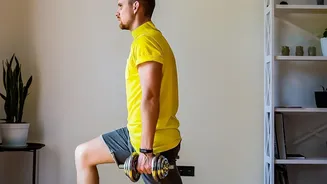
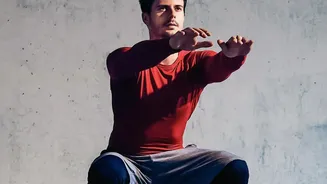
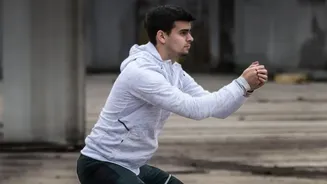
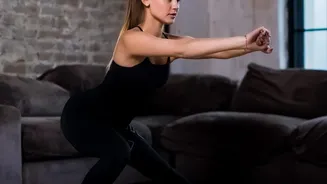
Proper form is crucial to get the full benefit of a lunge and avoid injury. Here's a step-by-step guide to the basic forward lunge: Start by standing tall with your feet about hip-width apart and your core engaged. Take a controlled step forward with one leg. Bend both knees to lower your body, aiming for 90-degree angles in both legs. Your front thigh should become parallel to the floor, and your front knee should be directly above your ankle, not drifting past your toes. Keep your torso upright and your chest lifted; avoid leaning too far forward or arching your back. Drive through your front heel to push yourself back to the starting position. Repeat on the other side. A common mistake is to step the front foot directly in line with the back foot, as if on a tightrope, which makes balancing much harder. Instead, imagine your feet are on train tracks, maintaining that hip-width distance as you step.
Easy Variations to Try
Once you've mastered the basic forward lunge, you can introduce variations to keep challenging your muscles. Reverse Lunges, where you step backward instead of forward, are often gentler on the knees and place a bit more emphasis on the glutes and hamstrings. Walking Lunges involve stepping forward into a lunge and then bringing your back foot forward to meet your front foot, continuing this 'walking' pattern. This variation adds a dynamic, cardiovascular element. For a different plane of motion, Side Lunges involve stepping out to the side and are excellent for targeting the inner and outer thighs. As you get stronger, you can add weight by holding dumbbells or kettlebells to increase the intensity.