





A Cosmic Data Deluge
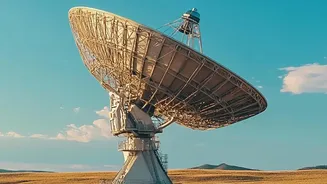
Observatories like the Vera C. Rubin Observatory in Chile are changing the way we see the universe. This facility alone can generate tens of terabytes of data every single night, capturing everything from distant galaxies to nearby asteroids. After ten years,
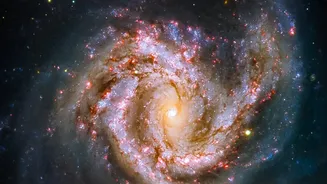
its Legacy Survey of Space and Time (LSST) is expected to produce a dataset of 500 petabytes, containing roughly 20 billion galaxies and a similar number of stars. This is more information than scientists could ever hope to analyse manually. Faced with this cosmic haystack, astronomers need a powerful new tool to help them find the needles: the rare, unusual, and scientifically valuable objects that could rewrite our understanding of the cosmos.
AI as the Ultimate Filter
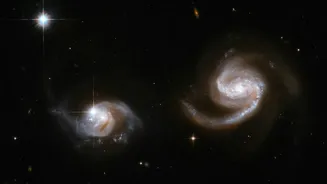
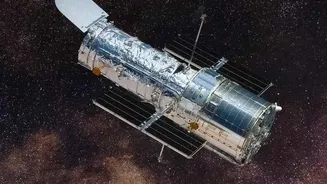
Artificial intelligence, specifically machine learning, has become that essential tool. These algorithms can be trained to perform tasks that would take humans a lifetime. Think of it like a highly advanced digital sieve. Scientists can teach an AI what a 'normal' galaxy or star looks like. The AI then scans millions of images at incredible speed, flagging anything that deviates from the norm. This allows it to spot anomalies—colliding galaxies, gravitationally lensed light, or the explosive death of a star—that a human might miss or simply never have time to see. In one recent project, an AI named AnomalyMatch sifted through nearly 100 million image cutouts from the Hubble Legacy Archive in just two and a half days, a task impossible for humans.
Training a Digital Astronomer
So how does it work? The process often involves using a neural network, an AI model inspired by the structure of the human brain. Researchers feed the AI thousands or millions of labeled images of known objects. For example, they can show it countless pictures of regular stars, asteroids, and different types of galaxies. The AI learns to recognise the patterns associated with each category. Once trained, it can classify new objects with remarkable speed and accuracy. More importantly, it can identify phenomena that don't fit into any of its trained categories, flagging them for human review. Some newer systems can even be trained with just a handful of examples to start spotting rare events like supernovae, the brilliant explosions of dying stars.
From Code to Cosmic Discovery
This technology is already yielding spectacular results. The AnomalyMatch AI, for instance, uncovered nearly 1,400 anomalous objects in the Hubble data, over 800 of which had never been documented before. These included rare 'jellyfish galaxies' and potential gravitational lenses. Other AI systems have been designed specifically to hunt for supernovae. One tool called the Bright Transient Survey Bot (BTSbot) can now autonomously detect a potential supernova, trigger a follow-up observation from another robotic telescope to confirm it, and share the discovery with the global astronomy community, all without human intervention. This automation is crucial for catching transient events, which can fade from view quickly.
A Human-AI Partnership
Despite the power of these automated systems, AI is not replacing astronomers. Instead, it's transforming their work. By handling the monumental task of filtering data, AI frees up scientists to do what they do best: interpret the most interesting findings, develop new hypotheses, and ask deeper questions about the universe. Many systems are designed as a 'human-in-the-loop' workflow, where the AI flags uncertain or particularly unusual candidates for an expert to review. This collaborative approach combines the speed and pattern-recognition of machine learning with the nuanced expertise and curiosity of the human mind, accelerating the pace of discovery for everyone.