
A Faint Glimmer in the Dark
Finding a new moon around Uranus is an astronomical feat of patience and technology. The most recent additions to the planet's family, like S/2023 U1 which was announced in early 2024, are incredibly faint and small. At only about 8 kilometres across,
S/2023 U1 is likely the smallest of Uranus's 28 known moons and was described as one of the faintest ever found using ground-based telescopes. Astronomers use massive telescopes, like the Magellan and Subaru telescopes, to take many long-exposure images. They then use special processing techniques to stack these images, allowing the faint, consistent movement of a potential moon to emerge from the background noise of distant stars and galaxies. It’s like trying to spot a single firefly in a forest during a lightning storm—from hundreds of miles away.
The Challenge of Pinning Down an Orbit
A few dots on a screen don't automatically mean you've found a moon. The most critical next step is to determine its orbit. Is it truly gravitationally bound to Uranus, or is it a passing object? To confirm this, scientists need to observe the object multiple times over weeks, months, or even years. For S/2023 U1, after its initial sighting in November 2023, astronomers had to find it again in follow-up observations a month later. Crucially, they were then able to locate it in older images taken as far back as 2021, providing a long enough observation arc to calculate a preliminary orbit and confirm it was, in fact, a moon. This process is painstakingly difficult because these outer moons have long, slow orbits. S/2023 U1, for instance, takes 680 days to circle Uranus. Missing an observation window can mean losing the object for years.
What Is It? From Where Did It Come?
Once an orbit is confirmed, the next set of questions emerges: What is the moon made of, and how did it get there? The faint, distant, and irregular orbits of these tiny moons suggest they are not homegrown, but rather 'captured' objects. Scientists theorize they were once free-floating bodies, similar to asteroids from the Kuiper Belt, that strayed too close to the ice giant and were snagged by its immense gravity. Studying their composition could provide invaluable clues about the raw materials that existed in the early solar system. However, determining their makeup from nearly 3 billion kilometres away is a massive hurdle. It requires spectroscopy—analyzing the faint sunlight that reflects off the moon's surface. The reflected light is so weak that it pushes the limits of even our most powerful telescopes.
Clues to a Violent, Clustered Past
These tiny moons are more than just cosmic curiosities; they are storytellers. Observations show that some of Uranus's outer moons travel in distinct orbital groups, or families. The newest moon, S/2023 U1, shares a similar orbital path with two other moons, Caliban and Stephano. This clustering strongly suggests they are not individual captures but are instead fragments of a single, larger parent moon that was shattered by a cataclysmic collision with a comet or asteroid long ago. Each new moon that fits into one of these families adds another piece to the puzzle, helping scientists reconstruct the violent history of the Uranian system. Understanding the dynamics of these moon families helps paint a broader picture of how all giant planet systems, including those of Jupiter and Saturn, evolved over billions of years.
The Need for Webb and Beyond
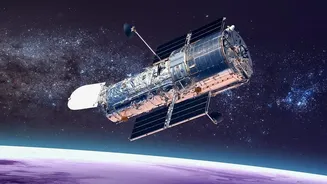
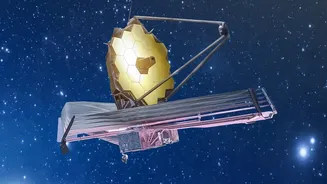
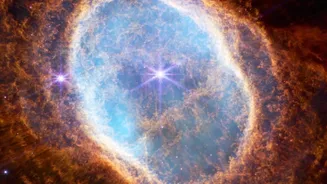
This is where the need for more and better observations becomes critical. Ground-based telescopes have done the heavy lifting of initial discovery, but to truly characterize these worlds, we need the unparalleled power of space-based observatories. The James Webb Space Telescope (JWST), with its incredible sensitivity in the infrared spectrum, is a game-changer. It can gather more of the faint light from these moons, allowing for more detailed spectroscopic analysis of their surface composition. Future dedicated missions to the ice giants, which are currently being planned, would be even better. A probe flying close to these moons could finally give us high-resolution images and precise measurements, turning these faint points of light into fully realized worlds and answering questions that remain stubbornly out of reach from Earth.