






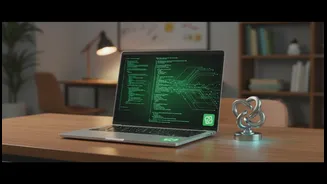


Beyond the Cloud AI Giants
When most people think of AI, they picture services like ChatGPT or Gemini, which run on massive, remote servers owned by tech giants. A small local language model is different. These are AI models with a few billion parameters instead of hundreds of billions,
compact enough to run entirely on a personal computer, like a modern laptop with a decent amount of RAM. Tools like Ollama and LM Studio have made it surprisingly simple for someone with a bit of technical skill to download and interact with these models completely offline. For students, this means they can have a powerful AI assistant without needing an internet connection or sending their data to a third-party server. This shift puts control, and the AI itself, directly into the user's hands.
The Allure of Privacy and Cost
The primary drivers behind this trend are privacy and cost. University lecture notes can contain unpublished research, personal thoughts, and intellectual property. Using a local model ensures this sensitive information never leaves the student's own device, eliminating risks associated with data breaches or corporate data mining. This is a fundamental privacy guarantee that cloud services, which often use customer data for training, simply cannot match. Furthermore, while premium cloud AI services come with recurring subscription fees, running a local model is free after the initial software setup. For students on a tight budget, this makes a huge difference. The ability to have an infinitely patient study partner at 3 a.m. without paying per query is a compelling proposition.
From Transcript Chaos to Study-Ready Notes
So, how are students actually using these models? A popular workflow begins with recording lectures and converting the audio to text using an offline tool. That raw transcript, often dozens of pages long, is then fed to the local language model. Students are using custom prompts to have the AI perform several tasks: automatically summarize the entire lecture into key takeaways, extract important keywords and concepts, generate a set of flashcards for revision, and even create practice questions based on the material. More advanced users are building personal search engines for their notes. By feeding all their course materials—transcripts, PDFs, and personal notes—into a system using a technique called Retrieval-Augmented Generation (RAG), they can ask their personal AI questions in plain language, like "what did the professor say about market failure?" and get an instant, sourced answer from their own files.
The Student Developer's Toolkit
This isn't just for computer science majors, but having some developer skills certainly helps. The ecosystem is built on open-source projects. Tools like Ollama, LM Studio, and Jan provide user-friendly interfaces to download and manage various models. The models themselves, such as Meta's Llama 3, Microsoft's Phi-3, and options from Mistral, are popular choices. These models are small enough to run on laptops but powerful enough to handle tasks like summarization and question-answering effectively. For instance, the Phi-3 model is noted for its strong reasoning capabilities despite its small size, making it ideal for academic work. Students can choose a model that best fits their computer's hardware and their specific needs, whether it's general knowledge or specialized reasoning.
Challenges and the Future of Personalized AI
The approach isn't without its hurdles. It requires a modern computer, typically with at least 16GB of RAM, to run smoothly. It also demands a higher level of technical comfort than simply logging into a website. Furthermore, these smaller models, while capable, can sometimes be less accurate or creative than their massive, cloud-based counterparts. However, the movement points toward a future of more personalized and private AI. As these small models become even more powerful and the tools to run them become easier to use, we may see a broader shift away from centralized AI services. For students, it represents a powerful way to reclaim ownership of their data and create customized learning tools that are perfectly tailored to their needs, all without breaking university integrity rules.