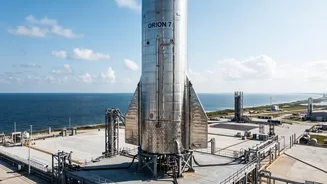








The Groundbreaking 'Catch'
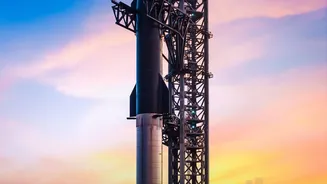
On Saturday, November 14, after a 22-hour orbital mission, the Starship upper stage (named Ship 42) plunged back through the atmosphere over Texas. Instead of landing on legs, it performed a complex belly-flop maneuver before flipping upright and descending
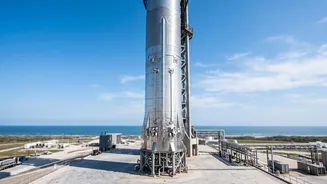
precisely into the waiting arms of the launch tower, a system nicknamed 'Mechazilla'. This was the first time any orbital spacecraft has been caught for recovery, a maneuver essential to SpaceX's goal of creating a fully and rapidly reusable rocket system. The concept, once seen as science fiction, aims to eliminate ocean splashdowns and allow for airliner-like turnaround times between launches, dramatically lowering the cost of accessing space.
What About the Booster Setback?
The mission, known as Flight 15, began on Friday with the goal of recovering both the Starship and its Super Heavy booster. While the Starship's journey was a success, the booster's was not. After propelling the ship toward orbit, the Super Heavy booster began its return flight to the launch site. However, a premature engine shutdown, reportedly due to a low fuel mass alarm, caused an anomaly. The booster’s guidance system automatically aborted the landing attempt at the tower and diverted it for a safer splashdown in the Gulf of Mexico, where it was intentionally destroyed by its flight termination system.
Why Did it Take 22 Hours?
The 22-hour duration mentioned was the length of the Starship's orbital mission, not the time it took to perform the catch. After lifting off from Texas on Friday evening, the spacecraft circled the Earth 14 times. During this journey, it successfully deployed 26 Starlink internet satellites into low Earth orbit. The extended flight was a planned part of the test, allowing engineers to verify the spacecraft's systems before initiating the high-stakes de-orbit burn and return for the landing attempt on Saturday afternoon. The catch itself was a maneuver lasting only minutes, the culmination of this nearly day-long mission.
A Major Leap Despite Mixed Results
In the world of iterative rocket development, a test flight doesn't have to be perfect to be a massive success. While the loss of the Super Heavy booster was a clear failure in the mission's secondary objective, the primary goal—surviving re-entry and being caught—was a resounding triumph. Catching the upper stage is considered far more difficult than catching the booster due to the incredible speeds and temperatures involved in returning from orbit. Proving the catch is possible provides crucial data and validates the core of SpaceX's architecture for future missions to the Moon and Mars. According to the company, the recovered Ship 42 appeared to be in good condition, potentially ready for another flight within weeks after some refurbishment.