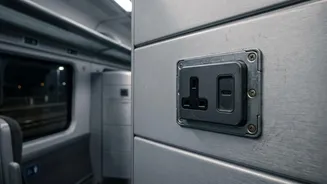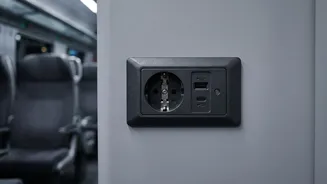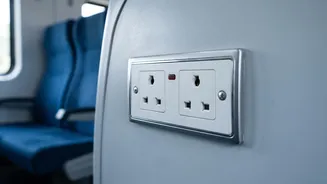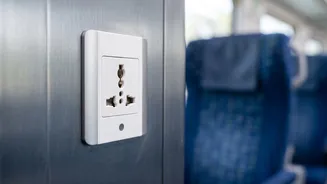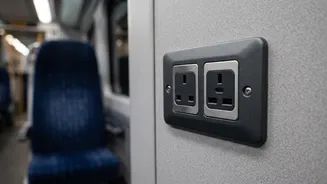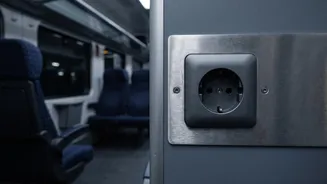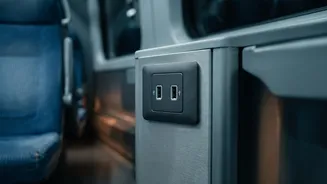








Indian Railways is enforcing a rule to turn off charging points on its trains between 11 PM and 5 AM. This move aims to enhance passenger safety by preventing potential fire hazards from overnight charging, but what does it mean for your next journey?
What Is The Rule?
The Railway Board has directed all railway zones to ensure that mobile phone and laptop charging points in train coaches are switched off for a six-hour period every night, from 11 PM to 5 AM. During this window, passengers will not be able to charge their electronic devices using the sockets provided in the coaches. This is not a new regulation but a strict reinforcement of a rule that has been in place for several years. The Railway Board has called for rigorous compliance, including staff training and surprise inspections by supervisors to make sure the power is cut off as mandated.
Why The Renewed Focus on Safety?
The primary driver for this strict enforcement is fire safety. The directive was recently reiterated after a concerning incident in the South Eastern Railway zone, where a passenger's power bank reportedly exploded and filled a coach with smoke while being charged overnight. According to the Railway Board, the onboard staff had not switched off the charging points during the restricted hours, highlighting a lapse in protocol. Overheating of devices like phones, laptops, and especially power banks, when left charging unattended for long hours, is a significant fire risk. The decision to enforce the shutdown is a preventative measure to avoid such accidents, which can have catastrophic consequences on a moving train.
A Rule Born From Past Tragedies
This safety protocol originally dates back to a recommendation made in 2014. The Commissioner of Railway Safety (CRS) first suggested the measure following a tragic fire incident in an AC coach of the Bengaluru-Hazur Sahib Nanded Express in December 2013. Initially, the rule was focused on AC coaches. However, after another fire broke out in a non-AC sleeper coach in November 2023, the CRS recommended extending the overnight charging shutdown to sleeper coaches as well. These past events underscore the critical importance of mitigating all potential fire risks, with electrical faults from charging devices being a key area of concern. The recent power bank incident served as a stark reminder for the railways to enforce existing safety rules without exception.
What This Means For Your Journey
For the millions of passengers who rely on trains for long distance travel, this rule means a slight adjustment to their routine is necessary. The six hour blackout period for charging sockets means you cannot leave your devices plugged in overnight. With the increasing reliance on smartphones for everything from tickets and identification to entertainment and communication, arriving at your destination with a dead battery can be a major inconvenience. Passengers will need to be more proactive in managing their device's battery life during their journey.
How to Prepare for Overnight Travel
A little planning can help you navigate the charging restrictions smoothly. The most straightforward solution is to ensure all your essential electronic devices—phones, laptops, and tablets—are fully charged before the 11 PM shutdown. It is also highly advisable to carry a fully charged, high quality power bank as a backup. You can use the charging sockets freely outside of the restricted 11 PM to 5 AM window to top up your devices. Additionally, using your phone’s battery saver mode, reducing screen brightness, and closing background apps can help conserve power overnight. The rule is a minor inconvenience when weighed against the significant increase in passenger safety.