








The Unspoken Reality of Silent Layoffs
The era of large, publicly announced layoffs seems to be fading, replaced by a more subtle and unsettling trend: silent layoffs. Unlike the mass job cuts of previous years, this new wave is happening quietly through performance-based exits, organizational
restructuring, and not backfilling roles. Staffing firms estimate that India's tech sector could see up to 35,000 such job reductions in 2026 alone. This approach, sometimes called 'quiet firing', allows companies to streamline their workforce without the negative press of formal announcements. For employees, it creates a stressful environment where job security feels precarious and performance metrics become the primary driver of one's future at the company. This isn't just about correcting for over-hiring during the pandemic; it's a structural shift driven by a relentless focus on efficiency.
The AI Productivity Paradox
Simultaneously, Artificial Intelligence is reshaping workplace expectations. Companies are investing heavily in AI, not just to innovate but to amplify productivity. This has created a paradox for employees: you are expected to master and use AI tools to become more efficient, yet there's a persistent fear that these same tools could make your role redundant. Studies show that while AI adoption is incredibly high among Indian professionals, it is also a significant source of stress and burnout. The pressure is no longer just to do your job well, but to constantly prove you can deliver more value than an algorithm. This pressure is particularly acute for entry-level and mid-level roles involving routine tasks, which are increasingly being automated.
Why Your Traditional Resume Is Not Enough
In this new landscape, a traditional resume is becoming insufficient. A CV that lists your job titles, responsibilities, and a handful of skills tells a potential employer what you were supposed to do, not what you actually accomplished. It’s a summary of claims, not a demonstration of capability. When companies are looking for individuals who can deliver immediate, quantifiable value in an AI-enabled environment, a list of past duties falls short. Hiring managers want proof of your problem-solving abilities, your technical judgment, and your impact. They need to see evidence that you can bridge the gap between knowing a skill and applying it to solve a real-world business problem. This is where the traditional format begins to fail.
Enter the Proof-of-Work Portfolio
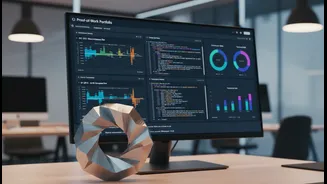
The answer to this challenge is a 'proof-of-work' portfolio. It is a curated collection of your projects and accomplishments that provides tangible evidence of your skills and impact. Think of it less like a resume and more like a series of case studies. For a developer, this could be a link to a GitHub repository with well-documented code. For a data analyst, it might be a project showcasing how you cleaned a dataset and derived actionable insights. For a cybersecurity professional, it could be a write-up of a vulnerability you identified and fixed. A proof-of-work portfolio is your professional story, told through tangible outputs, that demonstrates not just what you know, but how you think and the value you create.
Building a Portfolio That Proves Your Value
Creating a compelling proof-of-work portfolio doesn't require a massive collection of projects. Quality trumps quantity. Start by selecting two or three projects that are most relevant to the roles you are targeting. For each project, explain the problem you were trying to solve, the process you followed, the tools you used, and, most importantly, the outcome. Quantify your results whenever possible. Did your code improve performance by a certain percentage? Did your analysis lead to a specific business decision? Include artifacts like code snippets, architecture diagrams, or screenshots to make your contributions concrete. Host your portfolio on a personal website or a dedicated platform like GitHub Pages to make it easily accessible to recruiters. This living document becomes your career’s greatest asset, evolving as you acquire new skills and complete new projects.