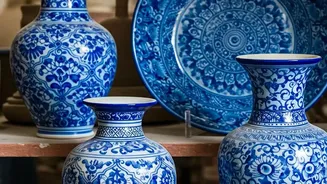





The brilliant cobalt blues and delicate floral motifs of Jaipur's Blue Pottery are instantly recognisable. But its most surprising feature isn't its beauty—it's the fact that these stunning ceramics are not made from clay at all.
The Secret Ingredient: A Body of Quartz
Unlike virtually all other
forms of pottery, which rely on the plasticity of natural clay, Jaipur's Blue Pottery is crafted from a unique, quartz-rich dough. The primary ingredient is quartz stone, which is ground into a fine powder. This is then mixed with powdered glass, borax, and a natural gum like Katira Gond. A small amount of Multani Mitti (Fuller's Earth) is also added, not as the main body but to provide some workability to the otherwise non-plastic mixture. This 'fritware' technique, with roots in ancient Egypt and Persia, results in a ceramic body that is entirely distinct from traditional earthenware or stoneware. The absence of clay means the material cannot be thrown on a wheel; instead, artisans press the stiff dough into plaster moulds to create their desired shapes.
From Persia with Love
The journey of Blue Pottery to Jaipur is a story of cultural exchange. The technique is Turko-Persian in origin, travelling to India with Mongol and Mughal influences. While it was initially used for creating decorative tiles for mosques, tombs, and palaces, it found a true home in Jaipur during the 19th century under the patronage of rulers like Maharaja Sawai Ram Singh II. The king is said to have been so impressed with the craft that he sent local artisans to Delhi to master it, eventually inviting Persian craftsmen to establish workshops in Jaipur. This royal support allowed the art form to flourish, blending its Persian aesthetic with local Rajasthani motifs of flowers, birds, and animals.
A Palette of Mineral Hues
The craft gets its name from the iconic, eye-catching blue derived from cobalt oxide. This brilliant pigment, along with a vibrant turquoise created from copper oxide, forms the traditional colour palette. These mineral-based colours are painted onto the dried quartz body with delicate squirrel-hair brushes before the final glazing. While modern artisans sometimes introduce other colours like yellow and brown, the classic blue-and-white combination remains the most celebrated and recognisable style. The hand-painted nature of each piece means that no two are ever exactly alike, with slight variations in the brushwork serving as a hallmark of authentic craftsmanship.
The Delicate Art of Fire
The making of Blue Pottery is a long and precarious process. After being shaped in moulds, the pieces are slowly dried for several days to prevent cracking. They are then smoothed, coated with a white slip of quartz and glass, and meticulously painted. Finally, a glaze is applied and the piece is fired in a special kiln. The firing temperature is relatively low, around 800-900 degrees Celsius. This lower heat helps keep the mineral colours bright and gives the glaze its signature glassy lustre. However, it also means the final product is more brittle and fragile than high-fired stoneware, making it better suited for decorative items like vases, tiles, and trinket boxes rather than heavy-duty tableware.
A Fragile Legacy in the Modern World
Today, Jaipur's Blue Pottery is protected as a Geographical Indication (GI) tagged product, which certifies its origin and traditional production method. This helps preserve the integrity of the craft and protects authentic artisans from imitation. Despite its fame, the craft faces challenges. The process is labour-intensive, with a single piece taking up to two weeks to complete, and the fragility of the items during firing means there is always a risk of loss. Nonetheless, hundreds of artisans in and around Jaipur continue to practise this unique art form, keeping a centuries-old tradition of clay-free pottery alive for a new generation of admirers.