






The Unforgiving Lunar Night
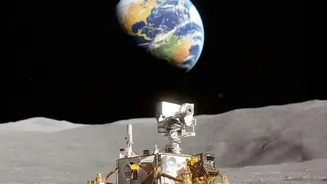
The Moon may be our closest celestial neighbor, but it is an environment of brutal extremes. With virtually no atmosphere to trap heat, the lunar surface experiences wild temperature swings. During its two-week-long day, temperatures at the equator can
soar to 127°C, hotter than boiling water. But when the sun sets, the temperature plummets for two straight weeks of darkness, reaching as low as -173°C. In the permanently shadowed regions near the poles, which are of high scientific interest for their potential water ice deposits, temperatures can drop even further to a staggering -250°C. For a lunar rover, lander, or any piece of scientific equipment, the lunar night is a life-threatening event. Batteries lose their ability to hold a charge in extreme cold, and sensitive electronics can freeze and crack beyond repair. Historically, many lunar missions were designed to last only a single lunar day, accepting that the mission would end when the sun went down. Overcoming this obstacle is the key to unlocking long-term science and establishing a sustainable presence on the lunar surface.
The Old Guard: Nuclear Warmth
The traditional solution for keeping spacecraft warm has been the Radioisotope Heater Unit, or RHU. These small devices are remarkably simple and reliable, containing a few grams of a radioactive material like Plutonium-238. As the material naturally decays, it releases a steady amount of heat—typically about one watt per unit—for decades. This consistent, gentle heat is enough to keep critical components just above their minimum survival temperature without any complex electrical systems. RHUs have been used successfully on missions from the Apollo era's seismometers to the Mars rovers Spirit and Opportunity and China's Chang'e rovers. However, this legacy technology has significant drawbacks. The Plutonium-238 fuel is scarce, expensive, and subject to intense regulatory oversight, making it difficult to produce and use. This has created a bottleneck, pushing space agencies and a growing number of commercial companies to develop innovative, non-nuclear alternatives to win the fight against the cold.
A New Generation of Thermal Tech
The next wave of lunar exploration is being driven by creative new ways to manage temperature. Instead of relying solely on constant heat, many new systems are focused on advanced insulation and smart thermal control. One promising area is the development of thermal switches. Engineers at Japan's Nagoya University, for example, have created a device that combines a Loop Heat Pipe (LHP) with a low-power pump. During the hot lunar day, it acts like a radiator, passively moving heat away from the electronics. During the cold night, the pump activates, using a tiny amount of power to block the flow of coolant, effectively turning the radiator off and trapping heat inside the rover's insulated core. Other companies, like Advanced Cooling Technologies, are working with commercial partners such as Astrobotic on similar systems, developing variable conductance heat pipes and thermal switches that can efficiently reject heat during the day and provide high thermal resistance to minimize heat loss at night.
Chemical Heat and Smarter Power
Another innovative, non-nuclear approach involves chemistry. One concept is the Metal Oxidation Warming System (MOWS), which uses controlled chemical reactions to generate heat when needed. This system can be turned off during the lunar day to prevent overheating and is projected to be much lighter than an equivalent battery-powered heating system. Beyond heating, smarter power systems are also key. Regenerative fuel cells offer a potential solution by using solar power during the day to split water into hydrogen and oxygen. During the night, these elements are recombined in a fuel cell to produce electricity and heat, creating a closed-loop energy system. Meanwhile, some companies are rethinking radioisotope power itself. Zeno Power is developing next-generation RHUs and plans to demonstrate a 'Survive-the-Night' package on a Firefly Aerospace Blue Ghost mission, scheduled for no earlier than 2028. These systems aim to make radioisotope technology more accessible and commercially viable for the burgeoning lunar economy.
Why Surviving the Night Matters
The ability to operate through multiple lunar day-night cycles represents a paradigm shift for lunar exploration. It transforms missions from short sprints into long-duration marathons, dramatically increasing the potential scientific return. Rovers will no longer be limited to exploring within a two-week window. They can traverse greater distances, study geological processes that evolve over time, and spend extended periods analyzing promising locations, such as the ice-rich craters at the lunar south pole. For the commercial space sector, lunar night survival is a business imperative. It enables the development of persistent infrastructure, from communication relays to landing pads and, eventually, a sustained human-tended Moon Base. By solving the thermal challenge, these innovative heating systems are not just keeping robots warm; they are unlocking the economic and scientific future of the Moon, paving the way for a permanent human foothold beyond Earth.