




The Universe’s Coolest Experiment
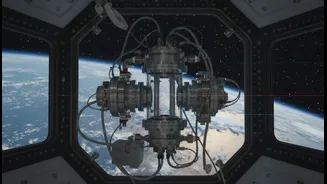
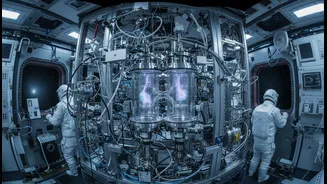
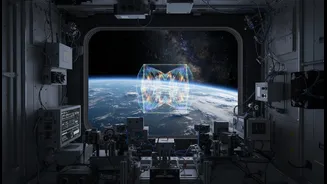
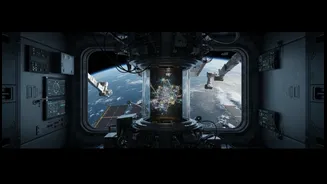
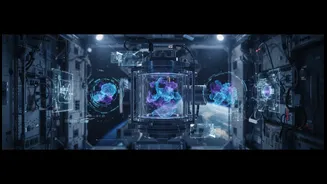
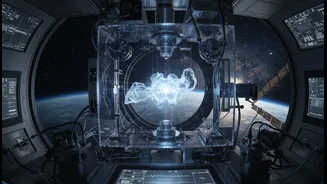
The instrument at the heart of this story is NASA’s Cold Atom Lab (CAL), a facility roughly the size of a mini-fridge that has been operating on the ISS since 2018. Its mission is to cool atoms to temperatures just a fraction of a degree above absolute
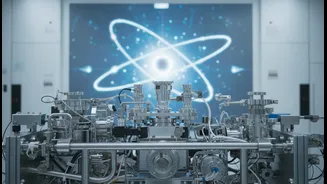
zero, about 10 billion times colder than deep space. At these extreme temperatures, atoms slow to a crawl and can enter a fifth state of matter, predicted in the 1920s by Albert Einstein and the celebrated Indian physicist Satyendra Nath Bose. This state, the Bose-Einstein Condensate (BEC), is unique. The atoms lose their individual identities and behave as a single, massive quantum wave. For scientists, this is revolutionary. It makes the strange rules of the quantum world—usually confined to the subatomic scale—visible on a macroscopic level, making them easier to study.
Why Microgravity is a Cheat Code for Physics
Creating a BEC is difficult enough on Earth, where room-sized laboratories are needed to hold the atoms in powerful magnetic traps, fighting against gravity’s constant pull. This is where the ISS provides a fundamental advantage. In the persistent free-fall of microgravity, gravity is no longer a factor. As a result, scientists can use much weaker magnetic traps. This allows the cloud of ultracold atoms to expand and cool even further, reaching temperatures and states impossible to achieve on the ground. More importantly, it allows scientists to observe the BECs for much longer durations—for over a second, compared to mere milliseconds on Earth. This extended observation window is crucial for conducting precise experiments that could unlock secrets about dark matter, dark energy, and the nature of gravity itself.
The Real Story: Surviving the Journey
The scientific promise of the CAL is immense, but the headline of this article points to a different, equally important truth. The transition from a controlled terrestrial lab to a functioning instrument in orbit is a brutal engineering challenge. The team at NASA's Jet Propulsion Laboratory had to shrink a room-sized experiment into a compact, automated box that could be operated entirely by remote control from Earth. This instrument also had to survive the violent shaking and extreme forces of a rocket launch. Robert Shotwell, CAL's project manager, noted the immense difficulty, stating that the facility “had to be completely torn apart and reassembled three times” because parts were breaking in ways the team had never seen before. This is the unglamorous reality of space deployment. For every elegant scientific theory, there are hundreds of engineering problems related to materials, electronics, and structural integrity that must be solved.
A Laboratory That Learns and Evolves
Perhaps the strongest evidence for CAL’s success as a deployed system is that it was designed not as a static experiment, but as an evolving platform. Since its installation, astronauts aboard the ISS have performed multiple complex upgrades. In 2020, astronaut Christina Koch installed new hardware, and in 2021, Megan McArthur used a mixed-reality HoloLens headset to help with another replacement, adding the ability to create BECs from potassium atoms in addition to rubidium. Recent upgrades in 2026 have introduced new electronics and a redesigned magnetic trap that allows scientists to actively alter the physical shape of the quantum gas clouds. This upgradability is the hallmark of a truly robust deployed system. It has transformed CAL from a one-off mission into a permanent, evolving quantum laboratory in orbit, a testament to forward-thinking engineering.
A Lesson for a Space-Faring Future
The story of the Cold Atom Lab serves as a crucial case study for the future of science and technology. As nations, including India with its ambitious space program, push further into the cosmos, the gap between laboratory promise and operational reality remains the biggest hurdle. Every grand vision, whether it’s a mission to Mars, a base on the Moon, or the deployment of next-generation quantum sensors for navigation and communication, is fundamentally an engineering challenge. The success of CAL demonstrates that the most profound scientific discoveries are built on a foundation of rugged, reliable, and often painstakingly developed hardware. It reminds us that for every spectacular image or groundbreaking data point from space, there is an unsung story of engineers solving problems that were once deemed impossible.