





A New Player in Deep Space
In the bustling tech landscape of India, a new frontier is being conquered not in software, but in the vastness of space. HEX20, a space-tech startup with its engineering hub in Technopark, Thiruvananthapuram, has positioned itself as a pivotal player
in an ambitious international deep-space mission. The company has become the first private Indian firm to be selected by the UAE Space Agency for such a project, contributing critical technology to the Emirates Mission to the Asteroid Belt (EMA). This collaboration marks a significant milestone, moving beyond the traditional domains of satellites and launch vehicles into the complex world of interplanetary exploration. Founded by a group of passionate engineers, HEX20 has quickly demonstrated its capability, having already launched satellites for international clients and established a global presence.
The Five-Billion-Kilometre Journey
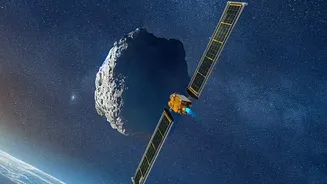
The mission is nothing short of audacious. Scheduled for launch in March 2028, the main spacecraft, named the MBR Explorer, will embark on an eight-year, five-billion-kilometre voyage. Using a series of gravity-assist manoeuvres around Venus, Earth, and Mars, it will navigate the main asteroid belt, flying past six different asteroids. Its ultimate destination is a scientifically compelling asteroid named 269 Justitia, which it is expected to reach in the mid-2030s. HEX20's contribution is a probe that will be carried by the MBR Explorer. This probe was engineered by HEX20, which delivered the spacecraft bus, mission software, onboard computer, and power systems in a remarkable 15-month timeframe. The probe was then assembled in Abu Dhabi by a consortium of partners.
What 'Autonomous Operations' Really Means
The centrepiece of HEX20's technological contribution is the probe's autonomy. Once the MBR Explorer reaches orbit around Justitia, it will release the HEX20-engineered probe to descend towards the asteroid's surface. Due to the immense distance, real-time communication with mission control on Earth will be impossible. The probe must therefore think for itself. This is what 'autonomous operations' entails. The software developed by HEX20 will allow the lander to execute its entire descent and data-gathering sequence independently, without any instructions from human operators. It will navigate, analyse its surroundings, and capture images as it makes what is planned to be a hard landing on the asteroid's surface. This capability is a massive engineering challenge and showcases a high level of sophistication in AI and robotics.
A Symbol of India's Growing Space Ambitions
HEX20's involvement in the EMA mission is more than just a single company's success; it is a powerful indicator of the maturation of India's private space ecosystem. For decades, India's space endeavours were synonymous with the Indian Space Research Organisation (ISRO). Private companies primarily served as component suppliers. However, policy reforms since 2020 have opened the doors for private firms to design, build, and operate their own missions. With over 400 space startups now active in India, the sector is buzzing with innovation, from building launch vehicles like Skyroot Aerospace's Vikram-1 to developing advanced satellite constellations. HEX20's deep-space contribution proves that Indian startups are now ready to compete on a global stage, providing high-tech, mission-critical systems for international partners.