




A Sugar Unlike Any Other
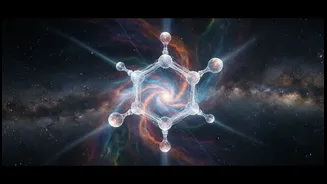
When we think of sugar, we might picture the crystals we stir into our morning tea. But the sugar found floating 27,000 light-years from Earth is a bit different. Erythrulose is a four-carbon sugar, a simple monosaccharide. On Earth, it's found in trace
amounts in fruits like raspberries and is also used in sunless tanning lotions. While you won't be sweetening your food with it, its discovery in space is far more exciting. Sugars are fundamental to life as we know it; they provide energy, build structures, and form the very backbone of our genetic material, RNA and DNA. This finding demonstrates that a key ingredient for life isn't just something that arose on Earth, but a compound that can form in the extreme conditions of deep space.
The Cosmic Chemical Factory
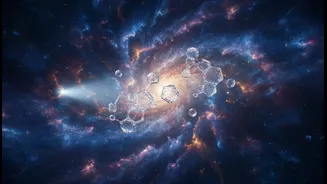
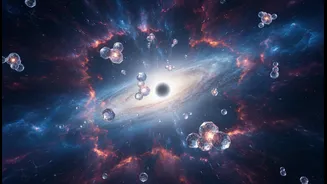
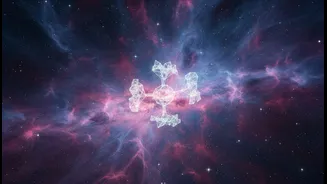
The discovery was made by an international team led by researchers from Spain's Centre for Astrobiology. Using powerful radio telescopes in Spain, they peered into a massive cloud of gas and dust near the center of our Milky Way galaxy called G+0.693-0.027. These molecular clouds are often called stellar nurseries because they are the places where stars and planets are born. They are also incredibly rich chemical factories. Despite temperatures hovering around -250°C, these clouds are cauldrons where simple atoms and molecules combine on the surfaces of tiny dust grains to form larger, more complex organic compounds. By analysing the specific frequencies of light, or 'spectral lines', coming from the cloud, astronomers identified the unique chemical fingerprint of erythrulose, finding 12 matching signals to confirm its presence.
A Key Clue to Life's Origins
So, why is finding this specific sugar such a big deal? The answer lies in the puzzle of abiogenesis, or the origin of life from non-living matter. Scientists have long wondered how the complex molecules necessary for life, like sugars, first appeared on the early Earth. One leading theory, the 'RNA World' hypothesis, suggests that RNA, not DNA, was the first genetic material. The 'R' in RNA stands for ribose, a five-carbon sugar. While erythrulose isn't ribose, it is a close chemical relative and a potential precursor. Finding erythrulose in interstellar space strongly suggests that the raw materials for RNA could have formed in space, been incorporated into asteroids and comets, and then delivered to young planets like Earth during a period of intense bombardment billions of years ago. Researchers estimate that millions of tonnes of erythrulose could have rained down on the early Earth, contributing to the 'prebiotic soup' from which the first life may have emerged.
An Unexpected Discovery
What surprised scientists was not just finding sugar, but which sugar they found. The prevailing theory was that complex molecules form by adding one carbon atom at a time. Based on this, the team expected to find simpler, three-carbon sugars but found no trace of them. Instead, they found the more complex four-carbon erythrulose in relative abundance. This suggests that it may have formed from the combination of two, two-carbon molecules that are known to be common in space. This discovery challenges previous assumptions and provides a new potential pathway for the formation of complex organic molecules in the cosmos, showing that the universe's chemical creativity is even greater than we imagined.