




The Galaxy's Coldest Traps
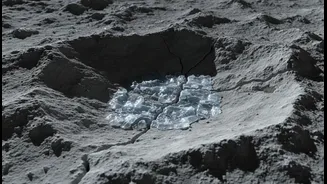
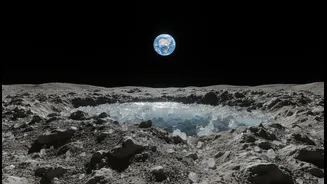
For decades, scientists theorized that if water existed on the Moon, it would be in the coldest places imaginable. Near the lunar poles, the Sun's rays skim the horizon, leaving the floors of some deep craters in permanent shadow. These aptly named Permanently
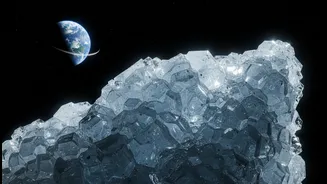
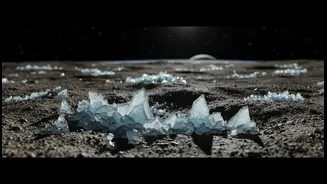
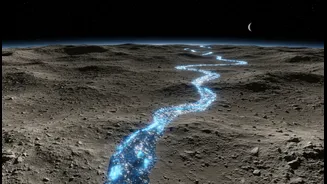
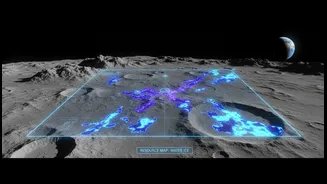
Shadowed Regions (PSRs) are among the coldest spots in our entire solar system, with temperatures plunging low enough to trap water ice for billions of years. Confirmation began arriving in waves, with multiple missions detecting signs of water. India's Chandrayaan-1 mission, carrying a NASA instrument, provided the first direct evidence of ice at the poles in 2009, a finding that transformed our understanding of the Moon. More recent data from missions like Chandrayaan-2 have continued to map these deposits, revealing that while the ice might be mixed with lunar soil or in patchy deposits, it is definitely there.
More Than Just a Drink of Water
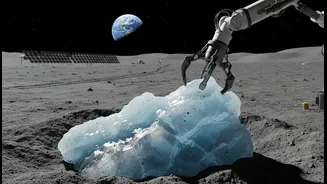
The excitement isn't just about giving future astronauts something to drink. Lunar ice is a game-changing resource with three critical uses. The first is life support: water can be purified for drinking and used for growing food in lunar greenhouses. By splitting the H2O molecule, it can also provide breathable oxygen. The second, and arguably most important, use is rocket fuel. When water is separated into its elemental components—hydrogen and oxygen—you have the two primary ingredients for powerful rocket propellant. This process, known as electrolysis, is relatively simple. Suddenly, the Moon isn't just a destination; it's a potential gas station.
A Fuel Stop on the Way to Mars
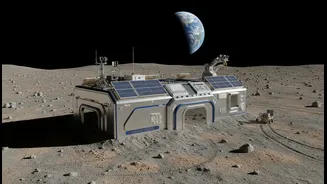
The concept of an interplanetary fuel depot is what makes lunar ice so revolutionary. The vast majority of a rocket's weight on Earth is its own fuel, needed just to escape our planet's strong gravity. Launching every drop of fuel needed for a long journey, like a mission to Mars, from Earth is incredibly expensive and inefficient. But what if a rocket could launch from Earth with just enough fuel to get to the Moon, top up its tanks, and then continue to Mars or beyond? This is the promise of In-Situ Resource Utilization (ISRU), or living off the land. By manufacturing propellant on the Moon, we could dramatically cut the cost and complexity of deep-space exploration, opening up the solar system in ways that were previously the stuff of science fiction.
The New Lunar Gold Rush
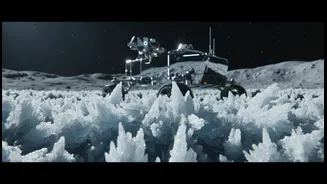
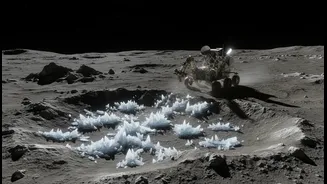
This potential has sparked a new kind of space race, this time focused on the Moon's south pole, where many of these ice-rich craters are located. NASA’s Artemis program, which aims to establish a sustainable human presence on the Moon, has explicitly targeted the south pole to take advantage of these resources. Rovers like the planned VIPER (Volatiles Investigating Polar Exploration Rover) are designed specifically to prospect for and map these ice deposits, figuring out where they are most concentrated and easiest to access. India, in partnership with Japan, is also planning the LUPEX mission to explore the same polar region. This global interest is turning the once-barren poles into a strategic location for the future of space travel.
The Deep Freeze Challenge
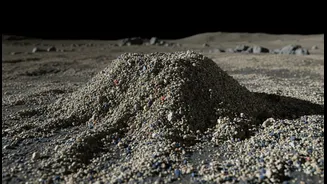
However, turning this vision into reality is a monumental engineering challenge. The very conditions that preserve the ice also make it incredibly difficult to access. Mining operations would have to take place in near-total darkness and at cryogenic temperatures, colder than the surface of Pluto. Robots and equipment will need to be designed to withstand this extreme environment, likely powered by batteries or beamed energy, as solar panels won't work inside the shadowed craters. The process of heating the frozen soil (regolith) to release the water vapor, collecting it, and then processing it is complex and energy-intensive. No one has ever attempted mining in such hostile conditions, and significant technological hurdles must be overcome before the first drop of lunar water can be converted into fuel.