



Decoding a Planet's Air
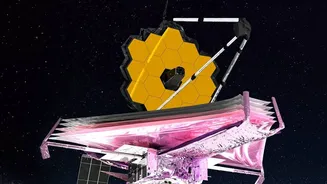
Before we can find water, we need to find air. The primary method Webb uses is called transmission spectroscopy. When a planet passes in front of its star from our perspective, a tiny fraction of the starlight filters through the planet's atmosphere.
The gases in that atmosphere absorb specific colours, or wavelengths, of light. By capturing the starlight that has passed through this atmospheric veil, Webb’s sensitive spectrographs can spread that light into a rainbow, or spectrum, and see which colours are missing. Each chemical element and compound has a unique light-absorbing fingerprint, allowing scientists to identify molecules like water vapour, carbon dioxide, and methane from light-years away. This technique is currently our most powerful tool for characterising the worlds orbiting other stars.
The Case of the Mysterious Vapour
Detecting an atmosphere around a rocky planet has proven incredibly challenging. One tantalising, but complex, case is GJ 486 b, a super-Earth about 30% larger than our planet. Observations with Webb showed hints of water vapour. This was exciting because GJ 486 b is a scorching world, orbiting its star so closely that its surface temperature is around 430 degrees Celsius. Finding an atmosphere here would suggest that some rocky worlds can hold onto their air even in extreme conditions. However, there's a catch. The water vapour signal might not be from the planet at all. The host star is a cool red dwarf, and its cooler regions, known as starspots, can also contain water vapour. Scientists are now working to determine if the signal is from a planetary atmosphere or just a case of mistaken identity from the star itself.
An Atmosphere Born of Lava
Another fascinating subject is 55 Cancri e, a rocky exoplanet so hot that its surface is likely a molten magma ocean. Here, Webb provided some of the best evidence to date for an atmosphere on a rocky exoplanet. Instead of a barren rock, thermal measurements showed the planet was cooler than expected, suggesting a blanket of gas was spreading the heat around. Scientists believe this is a "secondary atmosphere," not one from the planet's formation but one that is continuously being replenished by gases bubbling out of the magma ocean. This atmosphere is likely rich in carbon dioxide or carbon monoxide. While far too hot to be habitable, 55 Cancri e offers a unique laboratory for studying how planetary surfaces and atmospheres interact on extreme worlds, possibly giving us clues about the early, molten stages of planets like Earth and Venus.
The Elusive TRAPPIST-1 System
The TRAPPIST-1 system, with its seven Earth-sized planets, has been a prime target. Several of its planets are in the habitable zone, where liquid water could theoretically exist. However, Webb's observations have delivered sobering results. For planets like TRAPPIST-1 d, which once seemed promising, Webb found no evidence of a substantial atmosphere at all. Further studies of another habitable zone planet, TRAPPIST-1 e, have been inconclusive; it could have a nitrogen-rich atmosphere or be a bare rock. These findings highlight a critical lesson: being in the habitable zone isn't enough. Many rocky planets, especially those around active red dwarf stars, may have had their atmospheres stripped away by intense stellar radiation.
Water in a Planet-Forming Disc
Beyond looking at fully formed planets, Webb has also peered into the nurseries where they are born. In the PDS 70 system, the telescope detected abundant water vapour in the inner, rocky-planet-forming zone of the disc of gas and dust surrounding the young star. This was the first time water has been detected in the terrestrial region of a disc already known to contain planets. This discovery is extremely exciting because it suggests that rocky planets could be born with a local reservoir of water, rather than relying solely on later delivery by comets and asteroids. It provides evidence that the key ingredient for life as we know it might be a common component in the planet-formation process, increasing the odds that other habitable worlds could exist.