







The Power of an Unstable Surface
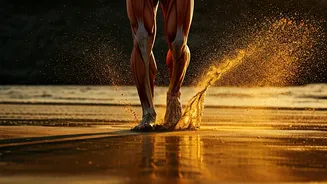
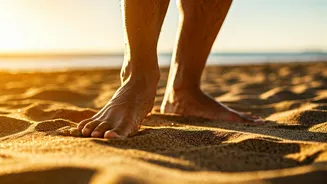
Working out on sand fundamentally changes the game for your body. Unlike a hard, flat surface like pavement or a gym floor, sand is unstable and yielding. Every step, jump, or lunge requires your muscles to work harder simply to maintain balance. This
constant micro-correction engages smaller, stabilising muscles in your legs, hips, and core that are often neglected in traditional workouts. The softness of the sand also acts as a natural cushion, reducing the high-impact stress on your joints—particularly your knees and hips. This creates a unique combination: a workout that is simultaneously more challenging for your muscles and gentler on your skeletal system, allowing for higher intensity with a lower risk of impact-related injuries.
Why Go Barefoot?
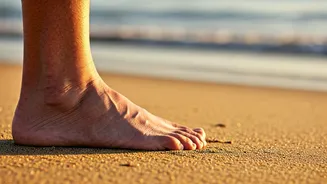
Kicking off your shoes is more than a symbolic gesture of freedom; it’s a bio-mechanical upgrade. Our feet are packed with nerves that provide crucial feedback to the brain about the ground beneath us—a sense known as proprioception. Shoes, especially cushioned trainers, dull this sensory information. By going barefoot, you reawaken this connection. Your feet can feel and react to the shifting grains of sand, sending rapid signals to your brain that improve your balance, coordination, and spatial awareness. This heightened feedback loop forces the intricate network of muscles and ligaments in your feet and lower legs to fire up, building strength from the ground up and creating a more stable foundation for all movement.
Unlocking Ankle Health and Mobility
This is where the magic happens for your ankles. The combination of an unstable surface and barefoot training creates the ideal environment for developing both ankle mobility (the range of motion) and stability (the strength to control that motion). As your foot sinks and moves with the sand, your ankle is guided through a wider, more varied range of motion than it would be on a predictable surface. This helps to break down stiffness and improve flexibility. At the same time, your stabiliser muscles—like the peroneals on the outside of your lower leg—are working overtime to prevent your ankle from rolling. Over time, this builds incredible strength and resilience, helping to protect you from common injuries like sprains. It’s this dual benefit of enhanced flexibility and strength that leads to what many experts consider a superior level of functional ankle health.
A Sample HIIT Sand Workout
Ready to try it? Find a clean, clear patch of sand. Perform each exercise for 40 seconds, followed by 20 seconds of rest. Complete the entire circuit 3-4 times. 1. High Knees: Drive your knees up towards your chest as quickly as you can, focusing on a quick foot turnover. 2. Squat Jumps: Drop into a deep squat and explode upwards, landing softly back in the sand. The resistance of the sand will make this extra challenging. 3. Barefoot Sprints: Mark out a 20-30 metre distance. Sprint at 80-90% effort, then walk back to recover before the next interval. 4. Walking Lunges: Step forward into a deep lunge, keeping your core tight. Push off the back foot and flow directly into the next lunge. The instability will test your balance. 5. Burpees: The ultimate full-body move. The push-up phase will feel different as your hands sink into the sand, engaging your stabilisers.
Start Smart and Stay Safe
While the benefits are significant, it’s crucial to approach sand workouts with caution. Your muscles and tendons will be working in new ways, so ease into it. Start with shorter sessions (15-20 minutes) once or twice a week. Always scan your workout area for sharp objects like shells, rocks, or debris before you begin. Listen to your body. The delayed onset muscle soreness (DOMS) might be more intense than you’re used to. If you feel any sharp or persistent pain, especially in your feet or Achilles tendon, stop and rest. If you have pre-existing foot or ankle conditions, it is essential to consult with a doctor or physical therapist before starting this type of training.